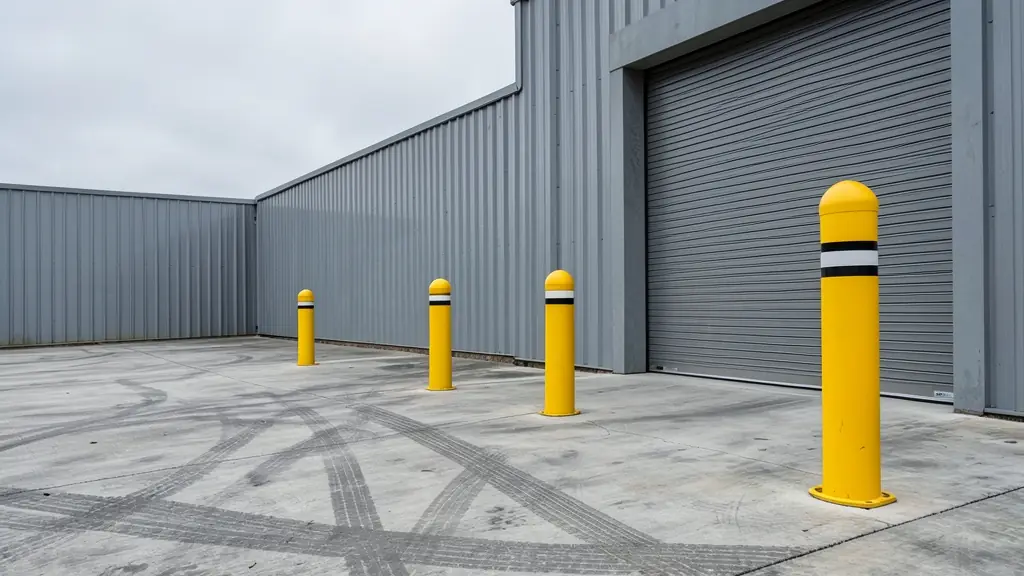
These are the sizes South African suppliers and installers talk about most. They are starting points for a specification or a quote request, not a design: the post, the footing and the spacing for your site come from your supplier, installer or engineer.
Bollard heights
Vehicle bollards usually stand about 900 mm to 1,200 mm above the finished ground. Lower posts get lost in front of a bonnet and are easy to reverse into; taller ones suit security work and places where people must see them from a distance. Bollard lights are often lower and are not impact posts unless built as one. Mark posts with reflective bands so they show at night.
Common steel pipe sizes
Most steel bollards are cut from round steel pipe, measured by the outside diameter. 114 mm and 168 mm are the common sizes; heavier posts use thicker or wider pipe and are often filled with concrete. The centre spacing and the posts for a 10 m line below are for a clear gap of 1 200 mm.
| Pipe (OD x wall) | Typical use | Centres at 1.2 m gap | Posts per 10 m |
|---|---|---|---|
| 76 mm (76.1 x 3) | Light guidance, garden and path posts, sleeves for removable posts | 1 276 mm | 9 |
| 114 mm (114.3 x 4.5) | The common general bollard: driveways, parking, shopfronts, walkways | 1 314 mm | 9 |
| 140 mm (139.7 x 4.5) | A heavier general post | 1 340 mm | 9 |
| 168 mm (168.3 x 4.5) | The common heavier bollard: car parks, loading areas, warehouse racking and doors | 1 368 mm | 9 |
| 219 mm (219.1 x 6) | Heavy duty: loading docks, columns, truck routes | 1 419 mm | 9 |
| 273 mm (273.1 x 6) | Very heavy posts and the outer tube of many security designs | 1 473 mm | 8 |
Wall thicknesses vary by supplier; the ones shown are typical. Precast concrete bollards come in many shapes and are often 250 mm to 450 mm across; ask for the drawing.
How deep in the ground
For impact posts, many installers bury about a third of the post, or set it 600 mm to 1,200 mm deep, depending on the design and the ground. The table shows what a third would be for the common heights, and the depth many would use as a minimum for an impact post.
| Height above ground | A third of the post in the ground | Impact post, often |
|---|---|---|
| 900 mm | 450 mm | 600 mm or more |
| 1 000 mm | 500 mm | 600 mm or more |
| 1 200 mm | 600 mm | 600 mm or more |
A crash-rated bollard goes in to the footing on its tested drawing; core drilled and surface-mounted posts follow the fixing's own instructions.
Gaps, bays and openings
| Measure | Usual figure | Notes |
|---|---|---|
| Clear gap between bollards | About 1,200 mm | Stops cars, lets people, prams and wheelchairs through |
| Gap for motorcycles and small cars | Closer than 1,000 mm | Leave a wider way through nearby |
| Bollards across an opening | One for every 1.5 m or so | Work out the exact count with the spacing calculator |
| Boom gate arm | Roughly 3 m to 6 m | Wider openings need a longer arm or two gates; see boom gates |