Get free quotes

Calculator

Bollard footing concrete calculator

How much concrete for your bollard footings and the fill inside steel posts, how many bags of cement, how much sand and stone, and how much soil comes out.

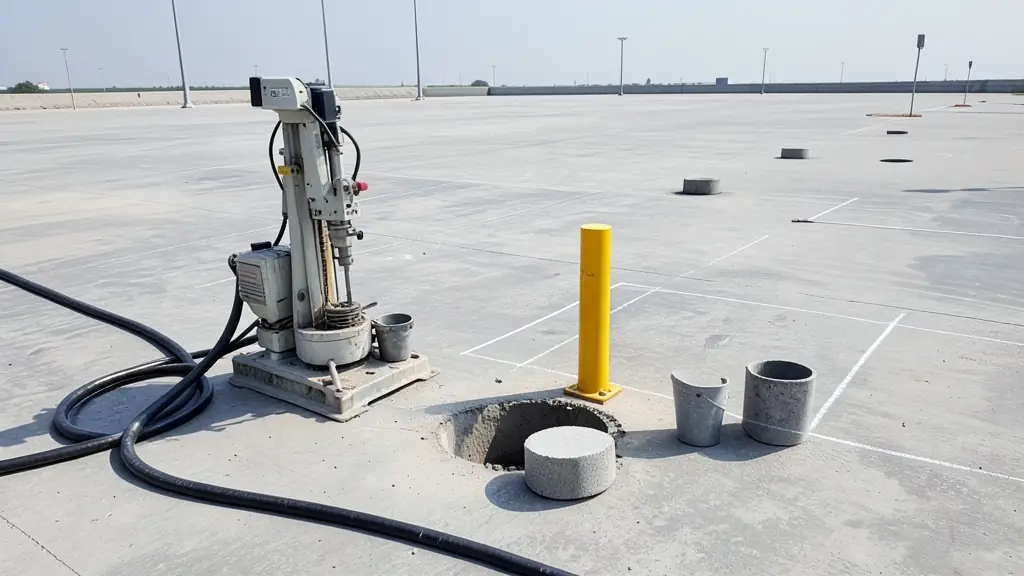
A steel bollard being set in a freshly dug footing hole in paving

Footing concreteCalc sheet BC-BOL-CAL-210, rev F

Hole
Use the size on your drawing or quote; a crash-rated footing is set by its design.
Concrete in all
0
Per post
0
Cement, 50 kg bags
0
Sand
0
Stone
0
Soil dug out
0

Section through one post and footing, to scale
Copies the post count and the footing into the site plan below.

Enter the number of posts, the post, its height and depth and the size of the hole. The concrete, cement bags, sand, stone and soil update as you type, and the section is drawn to scale.

How the footing calculator works

For each post it works out the volume of the hole (πd²/4 x depth for a round hole, side x side x depth for a square one) and takes off the part of the post that stands in it. If the post is a steel pipe and you fill it, it adds the inside of the pipe over its whole length, using the inside diameter left by the wall shown. Then it multiplies by the number of posts and adds the waste you choose.

The materials are for a 25 MPa mix: about 7 bags of 50 kg cement, 0.7 m³ of sand and 0.7 m³ of 19 mm stone for each cubic metre of concrete, from published South African mix tables. Sand and stone are sold by the cube (m³) or in bags; buy a little extra. The soil dug out is the volume of the holes before it bulks up, so allow for more when you book a skip or a truck.

Typical footings by job

Starting points only: your installer's design, or the tested drawing for a crash-rated post, always takes priority.

JobPostFixing
Garden path, guidanceLight post or timber poleShallow footing, or a spike or base plate
Driveway, parking, walkway114 mm steel pipe or precastFooting often 600 mm or more, post filled with concrete
Warehouse racking and doors168 mm steel pipe, filledCore drilled into the slab, or a footing where the slab is thin
Ram-raid and crash-ratedTested design onlyThe footing on the maker's drawing, often a beam joining the posts

Before you dig

  • Check for services first: cables, water and sewer pipes, fibre, gas lines, and post-tensioned or heavily reinforced slabs. Ask for service drawings or use a cable locator.
  • Into existing concrete, a diamond core drill and grout or resin may be quicker than breaking out a footing. See bollard installation.
  • Set each post plumb and at the right height, brace it, and let the concrete cure before anything bumps it.
  • Count the posts first with the spacing calculator.

Frequently asked questions

How deep should bollards be?
It depends on what the post must stop and on the ground. For impact posts, many installers bury about a third of the post, or set it 600 mm to 1,200 mm deep, depending on the design. Guidance and decorative posts can be shallower. A crash-rated bollard must go in exactly to the footing on its tested drawing, and shallow designs exist where services are in the way.
How much concrete do I need for a bollard?
Work out the volume of the hole and take off the part of the post that sits in it. A round hole of 350 mm across and 600 mm deep holds about 58 litres; a 114 mm post takes about 6 litres of that, so the footing is about 52 litres. Filling the post adds about 14 litres for a post 1 m above ground and 600 mm deep. Add 5 to 10% for waste. The calculator above does this for every post.
How many bags of cement per cubic metre?
Published South African mix tables give about 7 bags of 50 kg cement, 0.7 m³ of sand and 0.7 m³ of 19 mm stone for 1 m³ of 25 MPa concrete, the strength often used for footings. Check the mix on your cement bag or with your supplier, and follow your installer's or engineer's specification.
Should steel bollards be filled with concrete?
Steel posts are often filled with concrete for stiffness and so that a knock dents them less. The fill goes in with or after the footing. Galvanised and coated posts are usually filled on site; ask the supplier how their posts are made. See steel bollards.

Free quote request, no obligation

Send your footing for quotes

Draw up the site plan the way an installer would: what you are protecting, the length or the openings, the ground, where you are and how soon. Suppliers and installers in your area quote you directly.

Site planBollard Installation
Request
No. 18496
Rev
A, for quote
Drawn
2026-11-22

1The job

2Set out the line (optional, it helps the quote)

Plan view: the lineN ↑

-
-
-
-
-
-
Estimate
-

A rule of thumb, not a quote.

3Stage, ground and timing

4Your list (optional)

  1. 01
  2. 02
Up to 12 lines: posts, lights, gates, humps, barriers or cones.
Needs and options

5Your details

Free and no obligation. By sending you agree that we may share your request with suitable suppliers and installers. See our privacy policy.

Get free bollard quotes