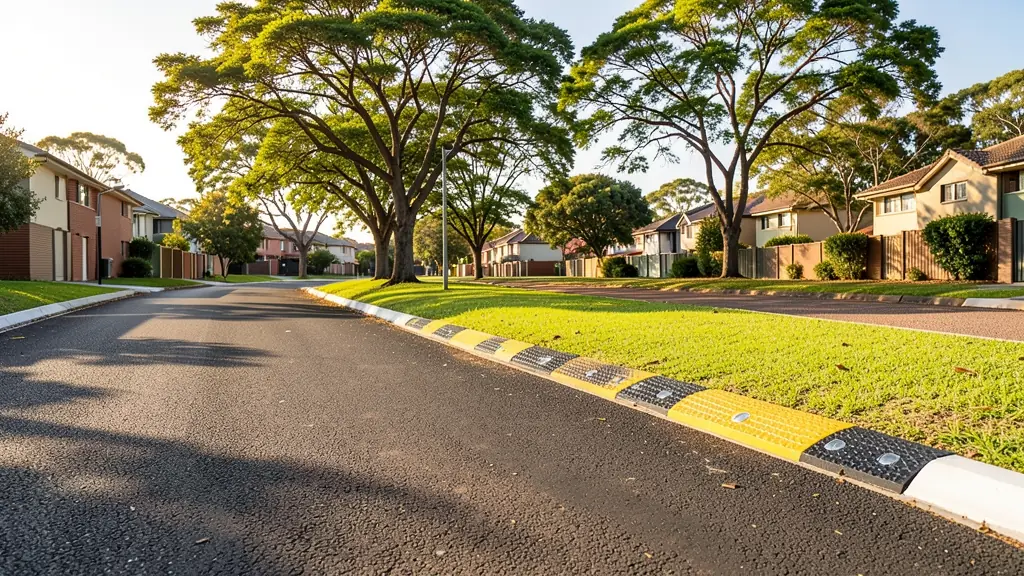
Speed humps are the plainest way to slow cars on a road you control: inside an estate or complex, at a school gate, through a car park or past a loading area. The trick is matching the hump to the road. Too sharp and drivers complain about their suspension or swerve round it; too gentle and nobody slows. Rubber humps can be bolted down in a morning, while asphalt or concrete humps are built in place. Give us the width of the road and how many humps you need, and we pass your request to independent road marking and traffic safety contractors, who quote you directly.
Speed bumps or speed humps
People use the words loosely, but there is a difference. A speed bump is short and sharp, crossed at walking pace, and suits car parks, drive-throughs and service lanes. A speed hump is longer and gentler, so cars slow down rather than stop, and it suits estate roads and longer streets. On a road with buses, delivery trucks or emergency vehicles, a longer hump is usually kinder to them. Ask the contractor which profile suits the speed you want, and think about who uses the road: low sports cars, loaded bakkies, refuse trucks and the ambulance that may one day need to get through quickly.
Rubber modular or built in place
Modular rubber or plastic humps come in sections, often black and yellow with reflectors, that are bolted into the tar or concrete across the road, with rounded end pieces at the kerbs. They are quick to install, can be moved, and a broken section can be swapped. The bolts can work loose on busy roads, so check them now and then. Asphalt or concrete humps are built in place, last longer and look neater, but take more time, need the road closed while they set, and are harder to remove. Mark them clearly with paint.
Private roads and public roads
Estates, complexes, schools and car parks on private land can usually install their own humps, subject to the body corporate or landlord. A public road is different: the municipality usually decides, after a request from residents and an assessment of the street, so ask the municipality before anyone installs anything there. Unofficial humps on a public road can be removed.
- Who owns the road
- Body corporate or landlord approval
- Paint and warning boards for each hump
Measuring and placing them
A hump runs across the full width of the road, so measure from kerb to kerb. Place humps where drivers can see them in time, away from sharp bends, and leave a drain channel open at the kerb so storm water can pass. Many complexes put one before the boom gates and others along long straights. At schools, pair them with parking bollards and traffic cones at the drop-off zone.
What to put in your request
- Road width at each hump, kerb to kerb
- Number of humps
- Rubber modular, asphalt or concrete
- Private road or public road
- Paint and warning boards needed
Speed Humps for homes, businesses and public spaces
- Homeowners: a short rubber bump on a long shared driveway with children playing nearby
- Estates, complexes and body corporates: a body corporate placing humps along estate roads and before the gatehouse
- Shops, malls and petrol stations: speed bumps through a shopping centre car park and past the trolley bays
- Offices, hotels and car parks: humps in an office park car park and along the delivery road
- Warehouses, factories and depots: bumps through a yard where trucks, forklifts and walkways cross
- Municipalities and public spaces: traffic calming on a residential street after a resident request and assessment
- Schools, hospitals and campuses: humps at a school gate and through the drop-off loop
- Contractors and event organisers: temporary rubber humps through a construction site or haul road
Frequently asked questions
Do you install speed humps yourselves?
Can I put a speed hump in my street?
Are rubber speed humps as good as asphalt ones?
What should I measure for a quote?
Speed Humps by province and city
- Johannesburg
- Pretoria
- Centurion
- Midrand
- Sandton
- Randburg
- Roodepoort
- Krugersdorp
- Randfontein
- Germiston
- Boksburg
- Benoni
- Kempton Park
- Alberton
- Vanderbijlpark
- Vereeniging
- Durban
- Pinetown
- Pietermaritzburg
- Richards Bay
- Newcastle
- Ladysmith
- Gqeberha (Port Elizabeth)
- East London
- Kariega (Uitenhage)
- Mthatha
- Cape Town
- Bellville
- Paarl
- Stellenbosch
- George
- Worcester
- eMalahleni (Witbank)
- Middelburg
- Secunda
- Mbombela (Nelspruit)
- Rustenburg
- Brits
- Klerksdorp
- Potchefstroom
- Mahikeng
- Polokwane
- Tzaneen
- Kimberley
- Upington
- Bloemfontein
- Welkom
- Sasolburg