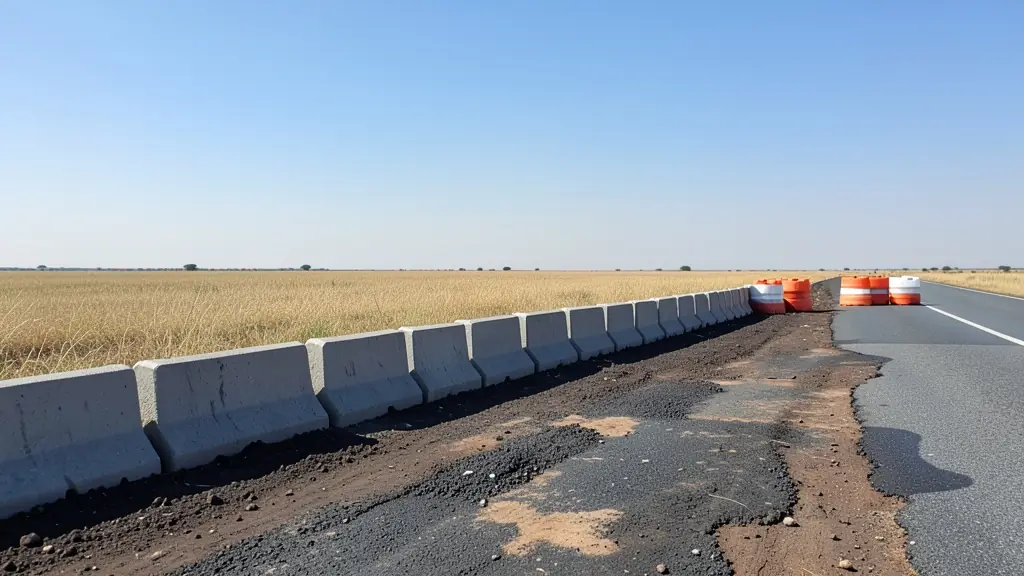
Road barriers separate traffic from something that must not be hit: a work zone, an open trench, a closed lane, an event, the edge of a site or a building. The two common kinds are precast concrete barriers with the New Jersey profile, which interlock into a continuous wall, and plastic barriers that are carried in empty and filled with water on site. Which suits you depends on how long they stay, how fast the traffic is and how you will move them. Give us the length and the place, and we pass your request to independent barrier suppliers and contractors, who quote you directly.
Concrete jersey barriers
A jersey barrier has a wide base and a sloped face that steers a vehicle's wheels back rather than letting the car hit a vertical wall. Units are precast at a yard in sections that interlock end to end, so a run behaves more like one wall. They are heavy, durable and need little looking after, which suits long road works, permanent closures, protecting a building edge and closing off a vacant site. Their weight is also the catch: delivery and placing need a crane truck, and every move costs a truck and a lift. Check that the ground is firm and level enough to carry them, and that the crane truck can reach the line without blocking the road it is protecting.
Water-filled plastic barriers
Water-filled barriers are hollow plastic units, usually red, white or orange, that link together and are filled with water through a cap once in place. Empty, two people can carry one; full, they are heavy enough to mark and hold a line. They suit events, short closures, car park changes and work zones where traffic is slow. They do not stop a vehicle the way concrete does, and in hot sun the plastic fades and can crack over time. Drain them before moving.
Buying, hiring and how many you need
Barriers are priced by the metre or by the unit. Measure the run, add the ends and turns, and divide by the length of one unit. Ask whether the supplier sells, hires or both; for a few weeks of work, hire is often cheaper. A quote should say:
- Unit length and the number of units
- Delivery, placing and collection
- Crane truck or lifting included or not
- Hire period and damage terms
Where barriers sit with the rest
Barriers carry the line; traffic cones mark the taper in front of them, and reflectors or lamps on top help at night. For a road edge that must stay protected for years, a steel guardrail may suit better. For a shopfront or pedestrian area that needs permanent protection, look at security bollards, which let people through.
What to put in your request
- Length of the run, ends and turns
- Concrete jersey or water-filled plastic
- Buy or hire, and for how long
- Crane truck access to the site
- Delivery, placing and collection
Road Barriers for homes, businesses and public spaces
- Homeowners: a short run of barriers closing a driveway or protecting a wall during building work
- Estates, complexes and body corporates: barriers closing an unused entrance or a road during repairs
- Shops, malls and petrol stations: barriers closing part of a car park or protecting a shopfront during works
- Offices, hotels and car parks: concrete barriers along a building edge or closing a vacant lot
- Warehouses, factories and depots: jersey barriers separating a yard from a road or protecting tanks and pipes
- Municipalities and public spaces: barriers closing a street to cars or protecting a work zone
- Schools, hospitals and campuses: water-filled barriers guiding traffic at a stadium or campus event
- Contractors and event organisers: jersey barriers hired for months of road works on a busy road
Frequently asked questions
Do you supply or hire barriers yourselves?
Concrete or water-filled: which should I choose?
Do I need permission to put barriers on a road?
How do I work out how many barriers I need?
Road Barriers by province and city
- Johannesburg
- Pretoria
- Centurion
- Midrand
- Sandton
- Randburg
- Roodepoort
- Krugersdorp
- Randfontein
- Germiston
- Boksburg
- Benoni
- Kempton Park
- Alberton
- Vanderbijlpark
- Vereeniging
- Durban
- Pinetown
- Pietermaritzburg
- Richards Bay
- Newcastle
- Ladysmith
- Gqeberha (Port Elizabeth)
- East London
- Kariega (Uitenhage)
- Mthatha
- Cape Town
- Bellville
- Paarl
- Stellenbosch
- George
- Worcester
- eMalahleni (Witbank)
- Middelburg
- Secunda
- Mbombela (Nelspruit)
- Rustenburg
- Brits
- Klerksdorp
- Potchefstroom
- Mahikeng
- Polokwane
- Tzaneen
- Kimberley
- Upington
- Bloemfontein
- Welkom
- Sasolburg