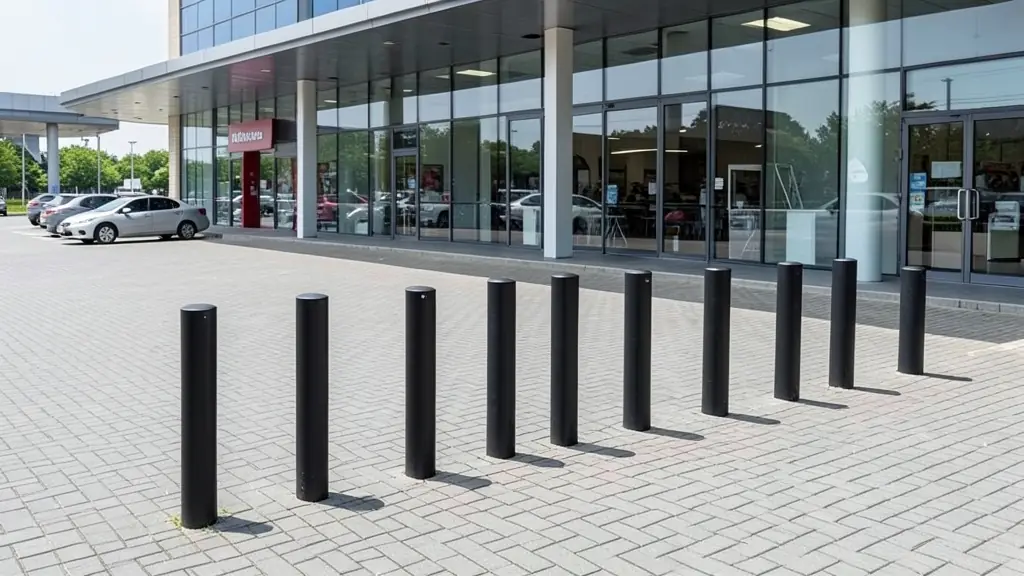
Security bollards stand between a vehicle and something you cannot afford to have hit: a shopfront, an ATM wall, a cash centre door, a building entrance or a walkway full of people. The word "security" covers a wide range, from a sturdy steel post set in a deep footing to a tested, crash-rated system, and to posts that only look the part. Tell us what you need to protect and how a vehicle could reach it, and we pass your request to independent bollard suppliers and installers in your area, who quote you directly and free.
What "security" should mean on a quote
There is no single meaning. A crash-rated bollard has been tested with a vehicle of a known weight at a known speed, and the rating holds only for the tested post, footing and spacing. A non-rated security bollard may be a solid concrete-filled steel pipe in a good footing, which will stop a lot, or a thin post that will fold at the first push. Ask each supplier what their post is built to stop and how they know. If you need a tested design, read our page on anti-ram and crash-rated bollards.
The strength is in the footing
A strong post in a shallow hole simply tips over. Security posts are usually cast into a reinforced concrete footing, and many installers bury about a third of the post or go 600 mm to 1,200 mm deep, depending on the design and the ground. Where cables, pipes or a basement are in the way, some makers offer shallow foundation designs that spread the load sideways instead. A base plate bolted to paving will deter, but it will not hold a hard hit. Our bollard installation page covers the digging and core drilling.
Spacing and the approach path
Many designers leave a clear gap of about 1.2 m between posts, which stops a car while letting people, prams and wheelchairs through. Look at the approach too: a straight run up a service road lets a vehicle build speed, while a corner or a kerb slows it. Count the posts as the length of the line divided by the centre spacing, plus one, and close any gap at the ends against a wall or planter.
- Shopfronts and mall entrances
- ATM walls and cash centres
- Government buildings, clinics and schools
- Gas meters, fuel lines and transformer kiosks
Steel, concrete or a cover
Most security posts are thick steel pipe, often filled with concrete, finished with galvanising and powder coat. A stainless steel sleeve over a steel core suits an office or hotel entrance. Large concrete bollards work where weight is enough and looks matter less. If staff need to drive through at times, ask about retractable or removable posts in the same line.
What to put in your request
- What the posts must protect and from what
- The length of the line and any openings
- The surface: paving, tar, slab or soil
- Whether you need a tested crash rating
- Any services or basements under the area
Security Bollards for homes, businesses and public spaces
- Homeowners: a front wall or gate protected from a car mounting the kerb on a busy road
- Estates, complexes and body corporates: posts around a gatehouse, clubhouse entrance and visitor parking edge
- Shops, malls and petrol stations: shopfronts, ATMs and mall entrances shielded from smash and grabs and ram raids
- Offices, hotels and car parks: office entrances and glass lobbies with posts set in a line across the forecourt
- Warehouses, factories and depots: gas meters, fuel lines and transformer kiosks kept clear of trucks
- Municipalities and public spaces: public squares and pedestrian streets closed to cars with fixed posts
- Schools, hospitals and campuses: schools, clinics, courts and government buildings with a protected front edge
- Contractors and event organisers: steel posts supplied and set in footings as part of a building contract
Frequently asked questions
Are security bollards the same as crash-rated bollards?
Can security bollards go into an existing slab or paving?
Do I need permission to put bollards on the sidewalk?
Do you supply or install the security bollards?
Security Bollards by province and city
- Johannesburg
- Pretoria
- Centurion
- Midrand
- Sandton
- Randburg
- Roodepoort
- Krugersdorp
- Randfontein
- Germiston
- Boksburg
- Benoni
- Kempton Park
- Alberton
- Vanderbijlpark
- Vereeniging
- Durban
- Pinetown
- Pietermaritzburg
- Richards Bay
- Newcastle
- Ladysmith
- Gqeberha (Port Elizabeth)
- East London
- Kariega (Uitenhage)
- Mthatha
- Cape Town
- Bellville
- Paarl
- Stellenbosch
- George
- Worcester
- eMalahleni (Witbank)
- Middelburg
- Secunda
- Mbombela (Nelspruit)
- Rustenburg
- Brits
- Klerksdorp
- Potchefstroom
- Mahikeng
- Polokwane
- Tzaneen
- Kimberley
- Upington
- Bloemfontein
- Welkom
- Sasolburg