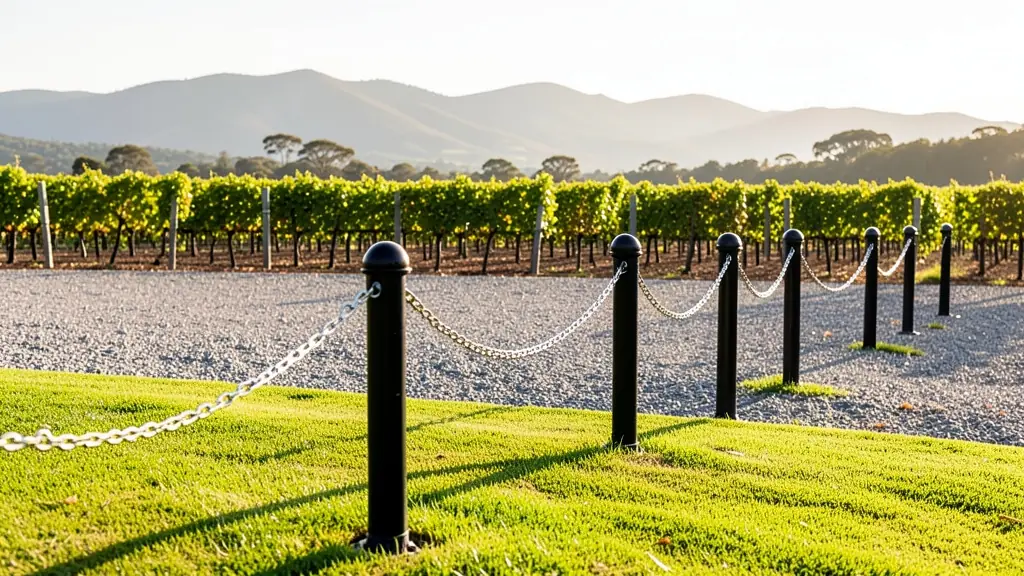
Bollards with chain mark a line without closing it. A row of posts with chain or rope looping between them keeps cars off a lawn, shows visitors where the walkway ends, frames a monument or guides a queue, and it looks a great deal softer than a fence. It is a visual barrier: it stops people wandering across and drivers parking where they should not, but it will not stop a vehicle. Tell us the length, the look and the ground, and we pass your request to independent suppliers and installers, who quote you directly.
Posts that take a chain
Chain posts have eyelets or rings near the top, either cast in or welded on, so the chain hangs at the same height all along the line. Common choices are cast iron or cast aluminium posts with ball tops for estates and heritage areas, precast concrete posts with steel eyelets cast in, steel pipe posts with welded rings, stainless posts for hotels and offices, and treated timber with eye bolts for farms and lodges. The post sets the look, so see decorative bollards and wooden bollards for the options.
Galvanised chain, plastic chain or rope
Galvanised steel chain lasts outdoors and is hard to cut, but it rusts at the coast once the coating wears; stainless chain costs more and suits salt air. Plastic chain in black, white, yellow or red and white is light, cheap, will not rust and is often used for temporary lines, car parks and events, but it fades in strong sun. Rope, usually a thick synthetic in a natural look, suits queue lines, museums and hotel entrances. Ask how the chain is fixed: shackles or S hooks let you unhook a section for access.
Spacing, height and sag
Posts for chain are usually lower and further apart than impact posts. Many lines use posts roughly 600 mm to 900 mm high, with a gap chosen so the chain sags evenly without dragging. Count the posts as the length divided by the spacing, plus one, and add posts at every corner and gap. Measure the chain along the sag, not post to post, and ask for a little extra.
- Length of the line and every corner
- Where you need an opening
- Post height and spacing
Fixing and where chain is the wrong choice
Chain posts carry little load, so they are often set in small footings, surface mounted on paving, or fitted in ground sleeves so the whole line can be removed for events. Low chain is a trip hazard for people who do not see it, so keep it clear of busy walkways at night. Where you need to stop vehicles, use proper posts instead; see bollards.
What to put in your request
- Length of the line, corners and openings
- Post type: cast, precast, steel or timber
- Galvanised, stainless or plastic chain, or rope
- Lawn, gravel, paving or slab
- Fixed posts or removable in sleeves
Chain and Post Barriers for homes, businesses and public spaces
- Homeowners: low posts and chain along a front lawn so cars stop parking on the grass
- Estates, complexes and body corporates: chain and posts around a clubhouse lawn and along the visitors' parking
- Shops, malls and petrol stations: plastic chain lines guiding queues and closing off part of a car park
- Offices, hotels and car parks: stainless posts and rope at a hotel or office entrance
- Warehouses, factories and depots: chain lines marking a walkway or a no-go area in a yard
- Municipalities and public spaces: cast posts and chain around a monument, square or park lawn
- Schools, hospitals and campuses: a school or church keeping cars off the grass with posts and chain
- Contractors and event organisers: temporary plastic chain and posts marking a site boundary or event line
Frequently asked questions
Do you supply the posts and chain yourselves?
Will a chain between bollards stop a car?
Can I take the chain down for events or deliveries?
How much chain do I need?
Chain and Post Barriers by province and city
- Johannesburg
- Pretoria
- Centurion
- Midrand
- Sandton
- Randburg
- Roodepoort
- Krugersdorp
- Randfontein
- Germiston
- Boksburg
- Benoni
- Kempton Park
- Alberton
- Vanderbijlpark
- Vereeniging
- Durban
- Pinetown
- Pietermaritzburg
- Richards Bay
- Newcastle
- Ladysmith
- Gqeberha (Port Elizabeth)
- East London
- Kariega (Uitenhage)
- Mthatha
- Cape Town
- Bellville
- Paarl
- Stellenbosch
- George
- Worcester
- eMalahleni (Witbank)
- Middelburg
- Secunda
- Mbombela (Nelspruit)
- Rustenburg
- Brits
- Klerksdorp
- Potchefstroom
- Mahikeng
- Polokwane
- Tzaneen
- Kimberley
- Upington
- Bloemfontein
- Welkom
- Sasolburg