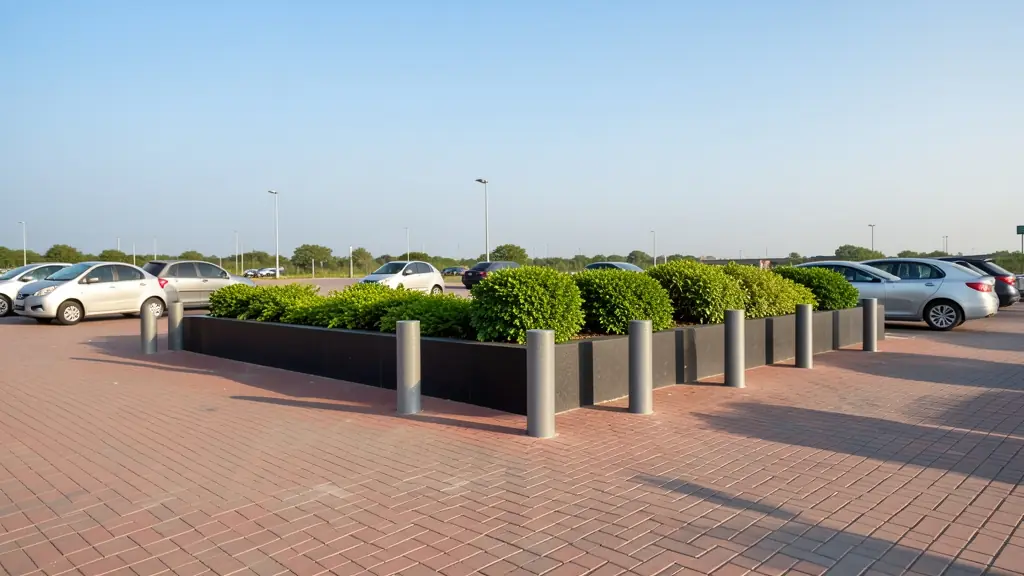
Bollards are short, sturdy posts that keep vehicles out of a space while people walk through it freely. They stand in front of shopfronts, along walkways, around pump islands and gas lines, at the ends of warehouse racking and across streets closed to cars. Some are there to guide and mark, others to take a real hit. This page explains the main types, the heights and gaps most designers use, how bollards are fixed, what moves the price and how to compare the quotes you get back from independent suppliers and installers.
The main types of bollards
Choose by what the post must do first, then by looks:
- Concrete bollards: precast, heavy and usually the cheapest per post.
- Steel bollards: pipe or square tube, often concrete filled, for impact and industrial sites.
- Stainless steel for offices and the coast, wooden posts for lodges and parks, plastic and flexible posts for guidance, bollard lights for paths and decorative bollards for heritage streets.
- For protection and access: security, anti-ram, retractable, removable and fold-down posts.
Heights and spacing
Vehicle bollards usually stand about 900 mm to 1,200 mm above the ground, high enough to be seen over a bonnet and to meet a bumper. Many designers leave a clear gap of about 1.2 m between posts: a car cannot squeeze through, but pedestrians, prams and wheelchairs can. Where small cars or motorcycles are the problem, the gap is often closer.
To count posts, divide the length of the line by the centre spacing and add one. A 12 m shopfront at 1.4 m centres needs about ten bollards. Measure the clear gap between the faces of the posts, not the centres, when you check it.
How bollards are fixed
The fixing decides how much a bollard can take. An impact post is cast into a concrete footing, and the depth of that footing and the ground around it matter as much as the post. Into an existing slab, a diamond core drill makes a neat hole and the post is grouted or set with resin. Surface mounted posts bolt down on a base plate: fine for guiding traffic, not for stopping a hard hit. Removable posts sit in a ground sleeve. Before any digging, check for cables, pipes and fibre. See bollard installation for the detail.
What affects the cost and how to compare quotes
Material and size set the base price, then the fixing method, the number of posts and access to the site add to it. Breaking up paving or tar, core drilling, removing rubble and reinstating the surface are real work and should be listed. Reflective bands, paint and caps may or may not be included.
Ask every supplier the same things: the post size and material, how deep it goes, what concrete or resin is used, who handles the paving and rubble, and how long the job takes. A cheap quote that bolts posts to the surface is not comparable to one that casts them in.
What to put in your request
- What the posts must protect and from what
- The length of the line and the gap you want
- The ground: soil, paving, tar or a concrete slab
- The material and finish you have in mind
- Photos of the area and any known services
Bollards for homes, businesses and public spaces
- Homeowners: a post or two to stop cars parking across the driveway or clipping the wall
- Estates, complexes and body corporates: posts along visitor parking and walkways so cars stay off the lawns and paths
- Shops, malls and petrol stations: a line of posts in front of shopfronts, ATMs and pump islands against reversing cars
- Offices, hotels and car parks: marking entrances and walkways at office parks and keeping bays and paths apart
- Warehouses, factories and depots: protecting racking ends, doors, gas lines and pedestrian routes from forklifts and trucks
- Municipalities and public spaces: closing streets to cars, protecting squares and keeping vehicles off sidewalks
- Schools, hospitals and campuses: protecting school drop-off zones, hospital entrances and crowded walkways
- Contractors and event organisers: supplying and setting posts on new builds and upgrades to the architect's layout
Frequently asked questions
What does a bollard actually stop?
Do I need permission to put bollards on the sidewalk?
How many bollards do I need?
Do you supply and install the bollards yourselves?
Bollards by province and city
- Johannesburg
- Pretoria
- Centurion
- Midrand
- Sandton
- Randburg
- Roodepoort
- Krugersdorp
- Randfontein
- Germiston
- Boksburg
- Benoni
- Kempton Park
- Alberton
- Vanderbijlpark
- Vereeniging
- Durban
- Pinetown
- Pietermaritzburg
- Richards Bay
- Newcastle
- Ladysmith
- Gqeberha (Port Elizabeth)
- East London
- Kariega (Uitenhage)
- Mthatha
- Cape Town
- Bellville
- Paarl
- Stellenbosch
- George
- Worcester
- eMalahleni (Witbank)
- Middelburg
- Secunda
- Mbombela (Nelspruit)
- Rustenburg
- Brits
- Klerksdorp
- Potchefstroom
- Mahikeng
- Polokwane
- Tzaneen
- Kimberley
- Upington
- Bloemfontein
- Welkom
- Sasolburg