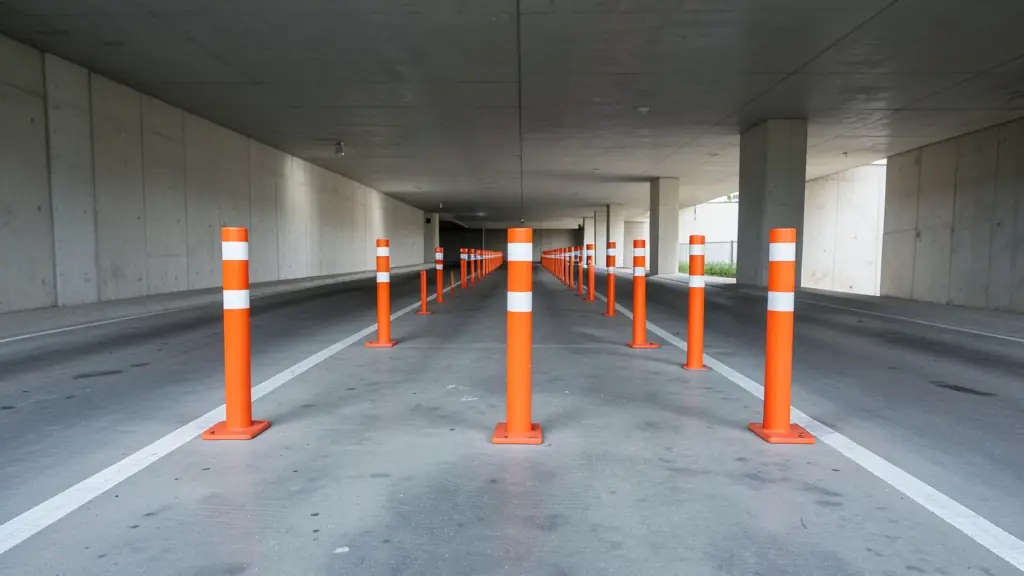
Plastic bollards and flexible posts do a different job from steel and concrete. They mark lanes, separate traffic, keep cars off a painted island and warn drivers where an edge is, then bend and spring back when a bumper catches them. They are light, quick to fit and cheap to replace. What they will not do is stop a vehicle. This page covers flexible spring-back posts, delineators and lane separators, recycled plastic posts and lightweight guidance bollards, where each works and how they are fixed.
Flexible spring-back posts
Made from polyurethane or rubber, a flexible post bends over when a vehicle runs into it and stands back up afterwards. That makes it ideal where knocks are frequent and nobody should be hurt or damaged by a hit: parking garage ramps, toll and access lanes, drop-off loops and painted islands. The post survives, the car usually only needs a wash. Over time, repeated hits and sun can tire the material, and a post that stays bent is simply unbolted and replaced. Heights vary: short posts of about 450 mm mark a kerb or island, taller ones of 750 mm to 1,000 mm are easier to see from a driver's seat. See bollard repairs.
Delineators and lane separators
Delineators are tall, narrow flexible posts, usually orange, yellow or white with reflective bands, set in a line to separate lanes or mark a route. Lane separator kits add a low rubber or plastic kerb between posts. They are used at estate entrances to split visitor and resident lanes, at the approach to a boom gate, in car parks and at road works. For temporary closures, traffic cones and road barriers are often used with them.
Recycled and lightweight plastic posts
Recycled plastic posts look a little like timber, do not rot and need no paint, which suits parks, beach paths and coastal parking where wood would weather quickly. Lightweight plastic bollards, often hollow and sometimes filled with sand or water for weight, mark walkways, queue lines and temporary areas. Plastic can fade and go brittle in strong sun over years, so ask about UV stabilisers in the material. Colour matters as well: yellow, orange and white stand out against grey tar, while black or green recycled posts blend into a park or garden.
What plastic bollards do not do
Be clear about the job. A plastic or flexible post guides and deters, it does not stop a car, let alone a truck. In front of a shopfront, a gas line or a crowded walkway, you need a post that can take a hit: see steel bollards or security bollards. In warehouses, flexible polymer barriers are a separate, heavier product built to absorb forklift knocks; see warehouse safety bollards.
What to put in your request
- Number of posts, height and colour
- Flexible spring-back or rigid plastic
- The surface: concrete, tar or paving
- Lane separator kerbs or bases needed
- Reflective bands for night use
Plastic and Flexible Bollards for homes, businesses and public spaces
- Homeowners: a flexible post marking the edge of a narrow driveway or a garden bed
- Estates, complexes and body corporates: splitting visitor and resident lanes at the gate and marking speed calming islands
- Shops, malls and petrol stations: drive-through lanes, parcel collection bays and car park islands
- Offices, hotels and car parks: parking garage ramps, basement lanes and office park drop-off loops
- Warehouses, factories and depots: marking truck routes and keep-clear zones in yards where hits are common
- Municipalities and public spaces: separating cycle lanes, taxi lanes and painted traffic islands
- Schools, hospitals and campuses: school drop-off loops and hospital parking lanes
- Contractors and event organisers: delineating lanes and detours at road works and events
Frequently asked questions
How are flexible bollards fixed down?
Will a flexible post damage my car?
Can plastic bollards stop a car from parking on my paving?
Do you supply the flexible posts?
Plastic and Flexible Bollards by province and city
- Johannesburg
- Pretoria
- Centurion
- Midrand
- Sandton
- Randburg
- Roodepoort
- Krugersdorp
- Randfontein
- Germiston
- Boksburg
- Benoni
- Kempton Park
- Alberton
- Vanderbijlpark
- Vereeniging
- Durban
- Pinetown
- Pietermaritzburg
- Richards Bay
- Newcastle
- Ladysmith
- Gqeberha (Port Elizabeth)
- East London
- Kariega (Uitenhage)
- Mthatha
- Cape Town
- Bellville
- Paarl
- Stellenbosch
- George
- Worcester
- eMalahleni (Witbank)
- Middelburg
- Secunda
- Mbombela (Nelspruit)
- Rustenburg
- Brits
- Klerksdorp
- Potchefstroom
- Mahikeng
- Polokwane
- Tzaneen
- Kimberley
- Upington
- Bloemfontein
- Welkom
- Sasolburg