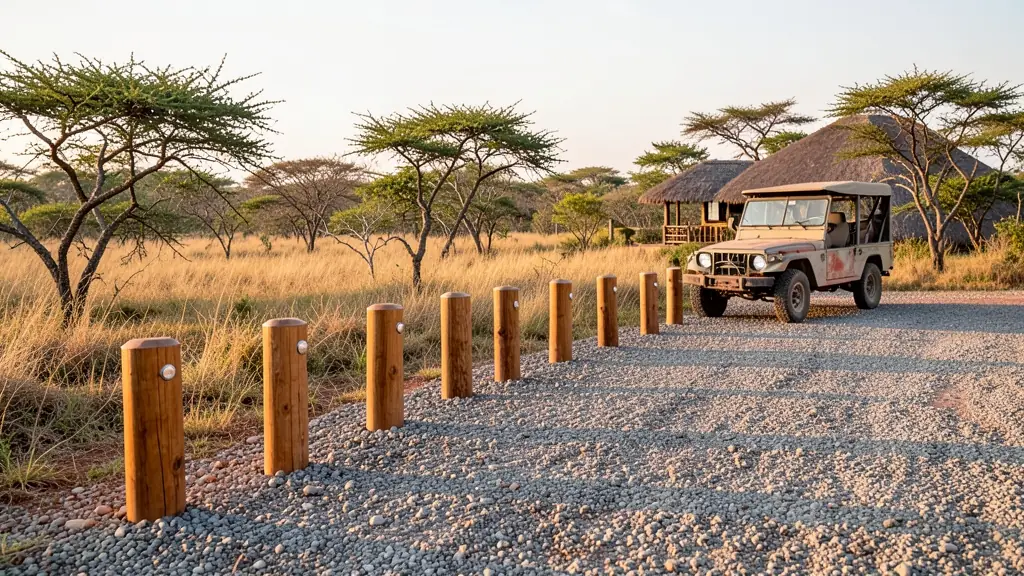
Wooden bollards suit places where steel and concrete would look out of place: game lodges, nature reserves, wine farms, picnic sites, beach parking and park edges. A row of round timber posts keeps vehicles off the grass or dunes and still looks natural. Timber is easy to work with, can be set with simple tools and is replaced one post at a time when it ages. This page covers treated pine against hardwood, the treatment to ask for, reflectors for night, where wood works well and how long to expect it to last.
Treated pine or hardwood
Most timber bollards are treated pine poles, round, debarked and pressure treated with CCA or creosote. They are affordable, straight and widely available. Creosote poles are darker and have a strong smell at first, so many people choose CCA poles near picnic areas and buildings. Hardwood posts are heavier, denser and often chosen for their look on upmarket estates and wine farms, though they cost more and are harder to source in consistent sizes. Typical poles range from slim garden posts to thick poles for parking edges.
Treatment for ground contact
In South Africa, timber that goes into the ground is usually specified as treated to hazard class H4. Lower classes are meant for wood above ground and will rot quickly in soil. Ask the supplier to confirm the class for the poles in your quote. Cutting a treated pole exposes untreated wood inside, so cut ends should be sealed, and the treated end should be the one that goes into the ground. A chamfered or rounded top sheds rain and slows splitting.
Setting the posts and seeing them at night
Wooden bollards are usually set in a hole and backfilled with compacted soil or gravel, or set in concrete where the ground is soft or the posts may be bumped. Gravel around the base helps water drain away from the wood. Timber deters and guides, but it will not stop a heavy vehicle driven at it. For posts that must take hits, look at steel or concrete bollards.
Dark wood disappears at night. Small reflectors or a band of reflective tape near the top make the line visible in headlights on dark farm roads and lodge parking. To mark a boundary with a rope or chain between posts, see chain and post barriers.
Lifespan and replacement
Timber rots or splits over the years, faster in wet ground, near the coast and where sprinklers keep the base damp. One advantage is that a tired post can be pulled and replaced on its own without touching the rest of the row. Ask the supplier whether they keep the same pole diameter in stock so replacements match. Keep a spare post or two after the first order, so a gap in the row can be filled quickly after a bakkie backs into it. See bollard repairs for replacing damaged posts.
What to put in your request
- Number of posts, diameter and height
- Treated pine or hardwood
- Confirm H4 treatment for ground contact
- Reflectors or reflective tape
- Ground type: sand, clay, gravel or rock
Wooden Bollards for homes, businesses and public spaces
- Homeowners: a row of timber posts keeping cars off the lawn on a smallholding
- Estates, complexes and body corporates: posts along nature trails, dams and open spaces in a country estate
- Shops, malls and petrol stations: farm stalls and padstal parking where steel would look out of place
- Offices, hotels and car parks: lodges, wine farms and wedding venues edging gravel parking
- Warehouses, factories and depots: marking haul road edges and yard boundaries on rural sites
- Municipalities and public spaces: park edges, picnic sites and beach parking above the dunes
- Schools, hospitals and campuses: school fields, campus green spaces and nature reserve parking
- Contractors and event organisers: supplying and setting long runs of poles on reserve and park projects
Frequently asked questions
How long do wooden bollards last?
Are treated pine bollards safe near children?
Can I get wooden bollards with reflectors?
Do you sell or install the wooden posts?
Wooden Bollards by province and city
- Johannesburg
- Pretoria
- Centurion
- Midrand
- Sandton
- Randburg
- Roodepoort
- Krugersdorp
- Randfontein
- Germiston
- Boksburg
- Benoni
- Kempton Park
- Alberton
- Vanderbijlpark
- Vereeniging
- Durban
- Pinetown
- Pietermaritzburg
- Richards Bay
- Newcastle
- Ladysmith
- Gqeberha (Port Elizabeth)
- East London
- Kariega (Uitenhage)
- Mthatha
- Cape Town
- Bellville
- Paarl
- Stellenbosch
- George
- Worcester
- eMalahleni (Witbank)
- Middelburg
- Secunda
- Mbombela (Nelspruit)
- Rustenburg
- Brits
- Klerksdorp
- Potchefstroom
- Mahikeng
- Polokwane
- Tzaneen
- Kimberley
- Upington
- Bloemfontein
- Welkom
- Sasolburg