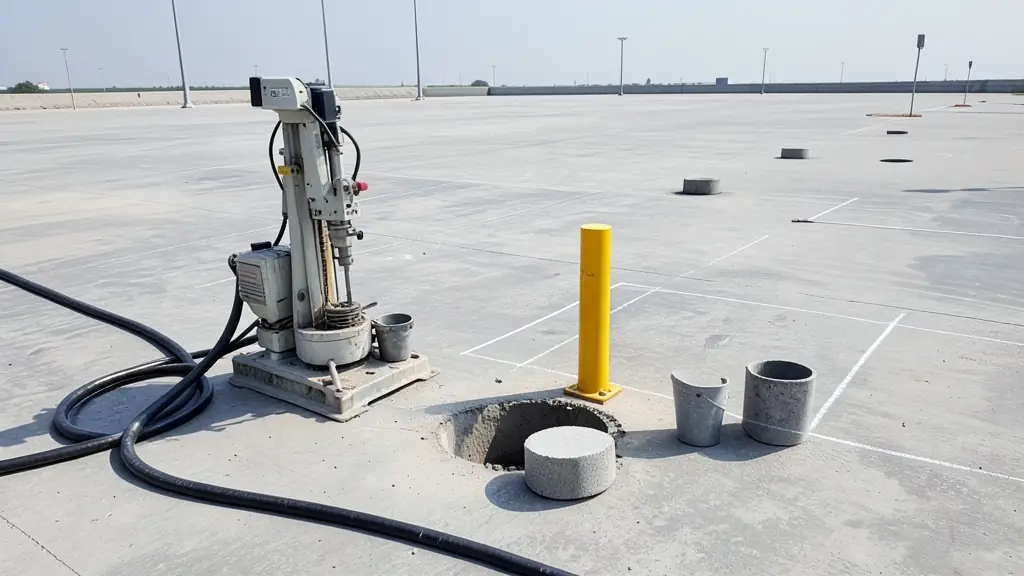
Good bollard installation is mostly about what happens below the surface. A strong post set in a shallow hole, or bolted to thin paving, will lean after the first bump. The method depends on what is there now: open ground or paving where a new footing can be cast, an existing concrete slab that has to be core drilled, or a floor where only a surface mounted post will go. Send one request with photos and the length of the line, and we pass it to independent installers in your area, who quote you directly.
Installing bollards in existing concrete
When the slab is already there, the usual way is core drilling. A diamond core drill, cooled with water, cuts a clean round hole a little wider than the post, through the slab and often into the ground below. The post is set plumb at the right height and the gap is filled with a non-shrink grout or a resin, depending on the design. Before anyone drills, the slab must be checked: how thick it is, whether it is reinforced, and whether it is a post-tensioned slab, where cutting a tendon is dangerous and costly. A thin slab may need the hole taken deeper into a new footing below it. This is the common method for warehouse safety bollards and for shopfronts on an existing forecourt.
Cast in footings and how deep to go
In open ground or under paving, the installer breaks out the surface, digs a hole and casts the post into a concrete footing. Many installers bury about a third of an impact post, or set it 600 mm to 1,200 mm deep, depending on the design and the ground. Clay, loose fill and sandy soil may need a wider or deeper footing; shallow rock may need drilling. Steel posts are often filled with concrete for stiffness. For security bollards the footing is part of the design, so follow the drawing exactly.
Check the services before anyone digs
Electrical cables, water and sewer pipes, fibre and gas lines often run exactly where bollards go: along shopfronts, past pump islands and down driveways. Ask for service drawings, have the line scanned with a cable locator, and ask the body corporate, landlord or municipality what runs there. Work on a sidewalk or in the road reserve usually needs a municipal wayleave first, so ask the municipality early.
- Service drawings or a scan of the line
- Slab thickness and reinforcement
- Wayleave if the posts are on municipal land
Surface mounted posts and what a quote must say
A post on a base plate with anchor bolts is quick and avoids deep holes, but it only guides and deters; it does not stop a hard hit. That suits plastic bollards and lane markers more than impact posts. Whatever the method, a good installation quote states the fixing method, the depth of the hole or footing, the concrete or grout used, the post height above ground, who breaks and reinstates the paving or tar, who removes the rubble, and whether painting and reflective bands are included.
What to put in your request
- Existing slab, paving, tar or open ground
- Number of posts or the length of the line
- Post type, or ask the installer to supply
- Any service drawings or known cables
- Who reinstates the paving and removes rubble
Bollard Installation for homes, businesses and public spaces
- Homeowners: two posts core drilled into a paved driveway so nobody parks across the gate
- Estates, complexes and body corporates: a line of posts cast in along visitor parking and the clubhouse walkway
- Shops, malls and petrol stations: impact posts core drilled into a shopfront forecourt after a ram raid scare
- Offices, hotels and car parks: posts set along an office entrance and car park walkway, with paving reinstated
- Warehouses, factories and depots: steel posts core drilled into a warehouse floor at racking ends and doors
- Municipalities and public spaces: posts cast in along a sidewalk under a wayleave to stop cars mounting the kerb
- Schools, hospitals and campuses: a school drop-off zone lined with posts set in new footings
- Contractors and event organisers: a subcontract for core drilling and grouting posts on a building project
Frequently asked questions
Do you install the bollards yourselves?
How deep should bollards be?
Can bollards be core drilled into any slab?
What should I send for an installation quote?
Bollard Installation by province and city
- Johannesburg
- Pretoria
- Centurion
- Midrand
- Sandton
- Randburg
- Roodepoort
- Krugersdorp
- Randfontein
- Germiston
- Boksburg
- Benoni
- Kempton Park
- Alberton
- Vanderbijlpark
- Vereeniging
- Durban
- Pinetown
- Pietermaritzburg
- Richards Bay
- Newcastle
- Ladysmith
- Gqeberha (Port Elizabeth)
- East London
- Kariega (Uitenhage)
- Mthatha
- Cape Town
- Bellville
- Paarl
- Stellenbosch
- George
- Worcester
- eMalahleni (Witbank)
- Middelburg
- Secunda
- Mbombela (Nelspruit)
- Rustenburg
- Brits
- Klerksdorp
- Potchefstroom
- Mahikeng
- Polokwane
- Tzaneen
- Kimberley
- Upington
- Bloemfontein
- Welkom
- Sasolburg