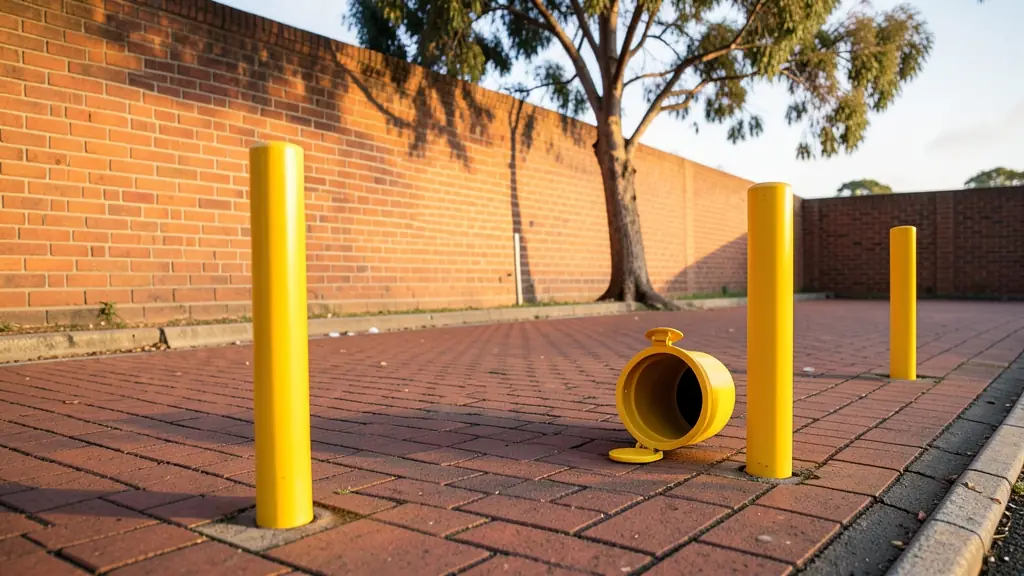
Removable bollards drop into a sleeve or socket set in the ground and lock in place with a key or padlock. When a vehicle needs to come through, you open the lock, lift the post out and close the lid over the socket so the surface is flat and safe to drive or walk over. They suit fire lanes, delivery entrances, event spaces and driveways that are only opened now and then. Tell us how many posts and where, and we pass your request to independent suppliers and installers who quote you directly.
How the sleeve and lock work
The installer casts a steel or stainless ground sleeve into a small concrete footing, flush with the paving. The post slides into the sleeve and locks with a cam lock, a key or a padlock through a pin. When the post is out, a lid, hinged or loose, covers the hole so a heel or a wheel cannot catch. Ask whether the lid locks too, and whether the sleeve has a drain hole, because a socket full of sand and water is hard to use.
Where removable posts make sense
- Fire lanes and emergency routes that must stay clear but open fast
- Delivery entrances used once or twice a week
- Squares and lawns used for markets and events
- A driveway where you park a trailer or caravan
If the post comes out several times a day, a fold-down or telescopic bollard stays on site and saves carrying it, and an automatic retractable bollard saves getting out of the car.
Weight, material and storage
A removable post has to be light enough to lift but strong enough to deter. Steel posts are usually galvanised and powder coated; stainless steel removable posts suit offices and coastal sites where rust shows fast. Ask how much each post weighs, whether it has a handle, and where it will be kept when it is out, so it does not walk off. A removable post deters and guides; it is not built to stop a hard hit. Reflective bands help on a dark service lane, and a chain between posts can mark the line on days the gap is open, as on our chain and post page.
Setting the sleeves
Each sleeve needs a small core or dug hole, a footing and paving made good around it. In an existing slab, an installer core drills and grouts the sleeve; in paving, they lift the pavers and cast a block. Check for cables and pipes first. Many designers keep about 1.2 m clear between posts so pedestrians and wheelchairs pass. Mix fixed and removable posts in one line: only the posts in the wheel track need to come out. See bollard installation for more on the fixing.
What to put in your request
- How many posts and the width of the opening
- The surface: paving, tar or concrete slab
- Steel, stainless steel or powder coated finish
- How often the posts will be lifted out
- Whether all posts should share one key
Removable Bollards for homes, businesses and public spaces
- Homeowners: a post that lifts out of the driveway when the trailer or caravan comes home
- Estates, complexes and body corporates: emergency access lanes kept closed with posts the body corporate holds keys for
- Shops, malls and petrol stations: delivery lanes at a small centre opened once a week for a truck
- Offices, hotels and car parks: office forecourts cleared for a function or a removal truck
- Warehouses, factories and depots: a side gate or walkway that opens only for maintenance vehicles
- Municipalities and public spaces: market squares and parks opened for event setup and cleaning trucks
- Schools, hospitals and campuses: school fields and campus walkways opened for sports days and deliveries
- Contractors and event organisers: sleeves cast in as part of new paving so posts can be added later
Frequently asked questions
Do all removable bollards use the same key?
Can I fit removable bollards to existing paving?
Will a removable bollard stop a car?
Are you the company that fits the bollards?
Removable Bollards by province and city
- Johannesburg
- Pretoria
- Centurion
- Midrand
- Sandton
- Randburg
- Roodepoort
- Krugersdorp
- Randfontein
- Germiston
- Boksburg
- Benoni
- Kempton Park
- Alberton
- Vanderbijlpark
- Vereeniging
- Durban
- Pinetown
- Pietermaritzburg
- Richards Bay
- Newcastle
- Ladysmith
- Gqeberha (Port Elizabeth)
- East London
- Kariega (Uitenhage)
- Mthatha
- Cape Town
- Bellville
- Paarl
- Stellenbosch
- George
- Worcester
- eMalahleni (Witbank)
- Middelburg
- Secunda
- Mbombela (Nelspruit)
- Rustenburg
- Brits
- Klerksdorp
- Potchefstroom
- Mahikeng
- Polokwane
- Tzaneen
- Kimberley
- Upington
- Bloemfontein
- Welkom
- Sasolburg