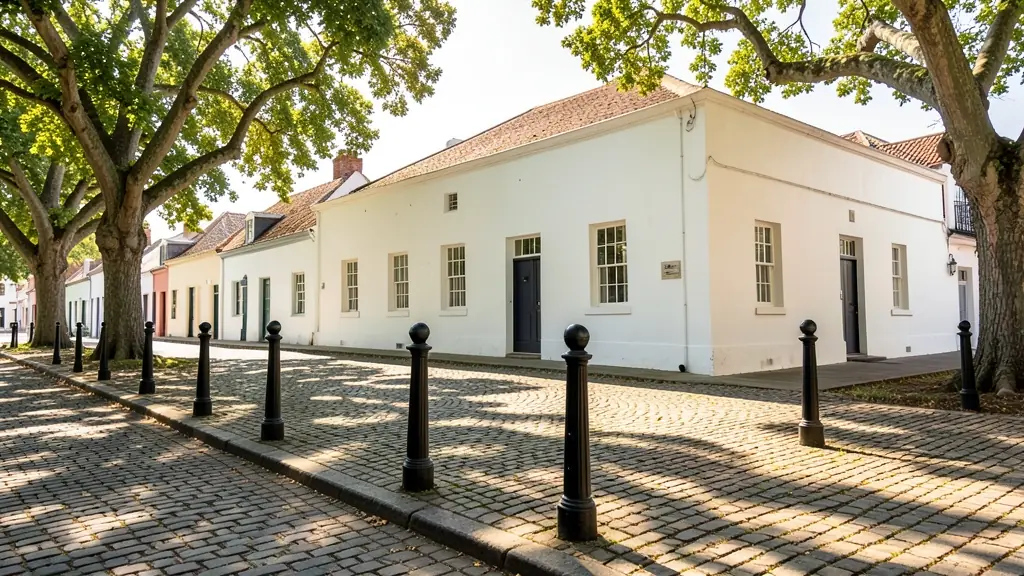
Decorative bollards are chosen as much for how they look as for what they do. A row of black cast iron posts with ball tops sets the tone of a heritage street, a turned concrete bollard suits a Cape Dutch wine estate, and a slim cast aluminium post fits a modern hotel entrance. They still mark edges and keep cars off squares and lawns. This page covers the materials, classic and modern shapes, chain rings, where decorative posts work well and how to make one tougher when looks alone are not enough.
Materials
- Cast iron: heavy and traditional, with crisp detail. It needs paint to stop rust and is the classic look for town centres.
- Cast aluminium: lighter, does not rust like iron and is easier to ship and handle, though it dents more easily.
- Cast concrete: turned or moulded shapes in grey, white or coloured concrete, sometimes with an exposed aggregate finish. See concrete bollards.
- Stainless steel in modern shapes; see stainless steel bollards.
Classic and modern shapes
Heritage designs use ball tops, fluted columns, collars and flared bases, often in black or dark green. Modern decorative posts are simpler: slim cylinders, cones, square sections or sculpted forms that double as seating. Some come with a light head, overlapping with bollard lights. Choose a shape that matches the building, paving and street furniture already on site, and ask for a drawing or sample before committing to a long run.
Colour is part of the design. Black, charcoal and dark green are traditional for iron; heritage areas sometimes have their own rules on colours and styles, so ask the municipality or the estate's design committee before you order. A reflective band can be added low on the post if cars pass at night, without spoiling the look in daylight.
Rings, eyelets and chains
Many decorative bollards have rings or eyelets cast in so a chain can hang between them. That turns a row of posts into a boundary for a lawn, a queue line at a venue or a soft edge around a monument. A galvanised steel chain lasts longer than plastic, while plastic chain is cheaper and lighter. A chain marks a line, it does not stop a car. See chain and post barriers.
Looks first, strength second
Most decorative posts are bolted to the surface or set shallowly, and they will guide traffic rather than stop it. Where a decorative look must also protect people, a cast iron or aluminium sleeve can fit over a steel core set in a concrete footing. Ask the supplier what is inside the post and how it is founded, and whether the decorative shell can be replaced if it is knocked or cracked. Cast iron can snap under a hard hit, while aluminium tends to dent. In crowded public squares, discuss this with someone who knows security bollards.
What to put in your request
- Material: cast iron, aluminium or concrete
- Style or a photo of the look you want
- Height and number of posts
- Chain rings or eyelets needed
- Whether the post must also take a knock
Decorative Bollards for homes, businesses and public spaces
- Homeowners: a pair of ball-topped posts at the gate of a period house
- Estates, complexes and body corporates: posts with chain around the clubhouse lawn and the entrance circle
- Shops, malls and petrol stations: heritage-style posts along lifestyle centre walkways and market squares
- Offices, hotels and car parks: hotel drop-offs, wine estate tasting rooms and wedding venues
- Warehouses, factories and depots: front-of-house visitor parking at a plant with a heritage building
- Municipalities and public spaces: heritage town centres, monuments and pedestrian squares
- Schools, hospitals and campuses: university quads, museums and historic government buildings
- Contractors and event organisers: supplying matched heritage posts on restoration and streetscape projects
Frequently asked questions
Are cast iron bollards still made?
Can a decorative bollard stop a vehicle?
How do I keep cast iron bollards looking good?
Do you make or install decorative bollards?
Decorative Bollards by province and city
- Johannesburg
- Pretoria
- Centurion
- Midrand
- Sandton
- Randburg
- Roodepoort
- Krugersdorp
- Randfontein
- Germiston
- Boksburg
- Benoni
- Kempton Park
- Alberton
- Vanderbijlpark
- Vereeniging
- Durban
- Pinetown
- Pietermaritzburg
- Richards Bay
- Newcastle
- Ladysmith
- Gqeberha (Port Elizabeth)
- East London
- Kariega (Uitenhage)
- Mthatha
- Cape Town
- Bellville
- Paarl
- Stellenbosch
- George
- Worcester
- eMalahleni (Witbank)
- Middelburg
- Secunda
- Mbombela (Nelspruit)
- Rustenburg
- Brits
- Klerksdorp
- Potchefstroom
- Mahikeng
- Polokwane
- Tzaneen
- Kimberley
- Upington
- Bloemfontein
- Welkom
- Sasolburg