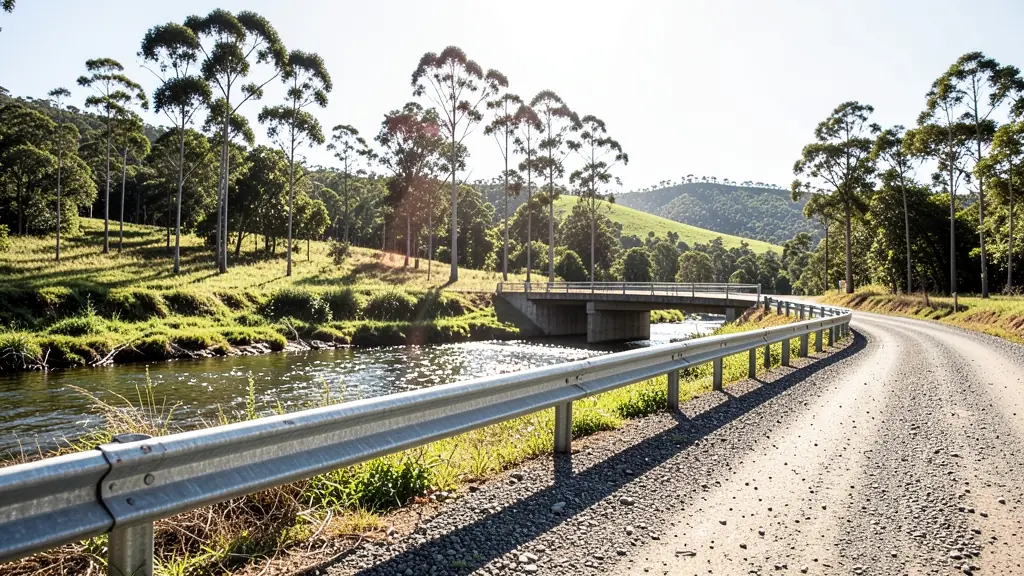
Guardrails stand along an edge where leaving the road would end badly: a bridge, an embankment, a sharp bend above a drop, a car park beside a ditch or a loading area beside a wall. The familiar kind is a galvanised steel W-beam rail bolted to posts, which bends and holds a vehicle that runs into it, steering it along the line rather than through it. It is priced by the metre, plus the end pieces. Give us the length, the ground and the place, and we pass your request to independent guardrail suppliers and installers, who quote you directly.
W-beam rail, posts and spacers
A W-beam is a galvanised steel rail pressed into a W shape, which gives it stiffness. Lengths overlap and bolt together, and the rail is fixed to posts, usually steel, at a set spacing, often with a spacer block between rail and post so a wheel does not snag on the post. Galvanising protects the steel for years; at the coast, or where cattle and fertiliser are about, check the coating more often. Ask the supplier for the rail length, post spacing and post type they propose, and how far the rail sits from the edge of the road.
Driven posts or posts in concrete
On open ground, posts are often driven straight in with a post driver, which is quick where the soil allows. Where there is rock, a slab, paving or a bridge deck, posts are set in concrete footings, core drilled or bolted to a base plate. Ground matters: clay, loose fill and shallow rock change the method and the price. Before driving posts along any road, check for cables and pipes in the verge, because driven posts find them the hard way.
End terminals and where the rail starts
The ends of a guardrail are the dangerous part. A blunt, square end facing traffic can spear a car. Ends are usually flared away from the road, bent down into the ground, or fitted with a proper end terminal. Allow for them in the length and the price, because each run needs two. On public roads, road authorities have their own specifications for guardrails and their ends, so private contractors working on a public road should ask the authority first.
- Two ends for every run
- Gaps for gates, drains and access
- Reflectors on the rail for night
Farm roads, car parks and loading areas
Away from public roads, guardrails protect farm bridges and dam walls, the edges of car parks above a slope, and loading areas where trucks reverse towards a wall, pipes or a drop. For a short edge, a line of steel bollards may do; for a temporary closure, road barriers can be moved when the job ends. In warehouses, look at warehouse safety bollards and rails made for forklifts.
What to put in your request
- Length of each run in metres
- Ground: soil, rock, paving or bridge deck
- Number of ends and any gaps
- Private land or a public road
- Photos and a sketch with distances
Guardrails for homes, businesses and public spaces
- Homeowners: a short rail along a steep driveway above a drop on a smallholding
- Estates, complexes and body corporates: rails along an estate road beside a dam or embankment
- Shops, malls and petrol stations: rails along the edge of a shopping centre car park above a slope
- Offices, hotels and car parks: a guardrail protecting a building wall from cars on a sloping car park
- Warehouses, factories and depots: rails in a loading area protecting pipes, tanks and walls from trucks
- Municipalities and public spaces: guardrails on a municipal road at a bridge or sharp bend
- Schools, hospitals and campuses: a rail along a campus road beside a stormwater channel
- Contractors and event organisers: a subcontract for supplying and installing W-beam on a civil project
Frequently asked questions
Do you install guardrails yourselves?
How are guardrails priced?
Can I put a guardrail along a public road?
What should I send for a guardrail quote?
Guardrails by province and city
- Johannesburg
- Pretoria
- Centurion
- Midrand
- Sandton
- Randburg
- Roodepoort
- Krugersdorp
- Randfontein
- Germiston
- Boksburg
- Benoni
- Kempton Park
- Alberton
- Vanderbijlpark
- Vereeniging
- Durban
- Pinetown
- Pietermaritzburg
- Richards Bay
- Newcastle
- Ladysmith
- Gqeberha (Port Elizabeth)
- East London
- Kariega (Uitenhage)
- Mthatha
- Cape Town
- Bellville
- Paarl
- Stellenbosch
- George
- Worcester
- eMalahleni (Witbank)
- Middelburg
- Secunda
- Mbombela (Nelspruit)
- Rustenburg
- Brits
- Klerksdorp
- Potchefstroom
- Mahikeng
- Polokwane
- Tzaneen
- Kimberley
- Upington
- Bloemfontein
- Welkom
- Sasolburg