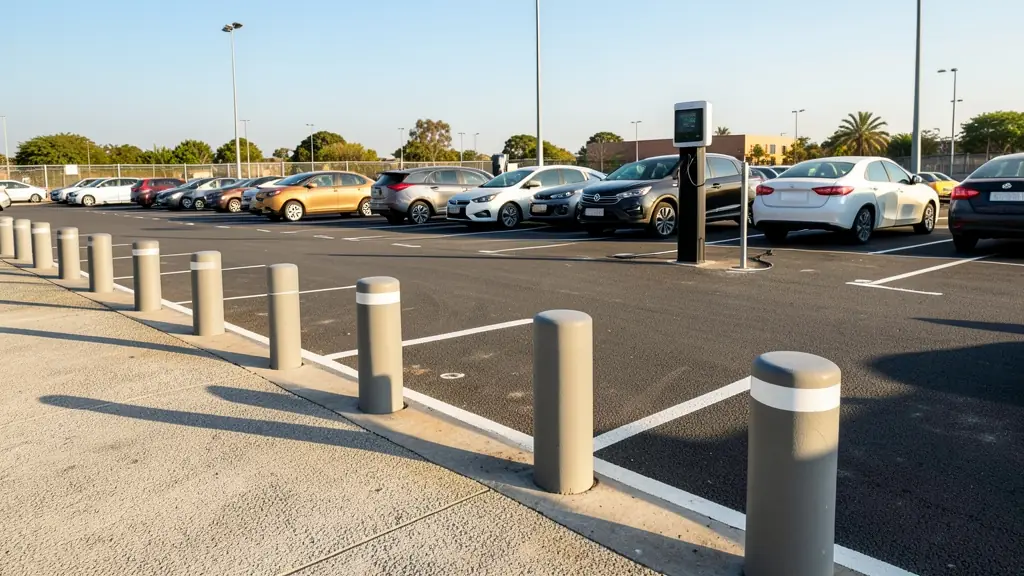
Parking bollards are the posts that stop a car before its bumper reaches a walkway, a shopfront, a column or a pay machine. They also mark the end of a bay, keep cars off paving and planting, and, as lockable posts, hold reserved bays for the right car. In a busy car park they take knocks every week, so the choice of post and fixing matters. Describe the car park and what needs protecting, and we pass your request to independent bollard suppliers and installers in your area, who quote you directly.
What parking bollards protect
- Walkways and shop entrances at the head of a row of bays
- Columns and walls in basements and parking garages
- Pay machines, EV chargers and trolley bays
- Paving, planters and lawns that drivers cut across
- Gas meters, water meters and kiosks at the edge of the lot
Each one needs a post strong enough for a slow knock, which is most car park hits. Start with a walk around the car park and note the scuffed kerbs, cracked paving and dented columns: they show where drivers misjudge the turn and where a post will earn its place.
Concrete, steel or flexible
Precast concrete bollards are common in open car parks: they are cheaper than steel, heavy and easy to see with a reflective band, but they chip after repeated hits. Steel bollards, often concrete filled and painted, take knocks better and suit EV chargers and columns. In parking garages, flexible bollards separate lanes and mark ramps, bending over when clipped and springing back, though they guide rather than stop.
Reserved and wheelchair bays
A lockable post at the mouth of a bay keeps it free for one person. For a few bays, fold-down or telescopic posts are the usual choice. Wheelchair bays need clear space beside the car, so keep posts out of the access zone and make sure the walkway beyond stays open: many designers leave about 1.2 m clear between posts so wheelchairs, prams and trolleys pass. At a shopping centre, check that trolley routes from the entrance to the bays still work once the posts are in, or shoppers will push trolleys between cars instead.
Seeing them at night
A low grey post disappears behind a bonnet when a driver reverses. Reflective bands, yellow or white paint, and a height around 900 mm help. In dark car parks, posts near a light or bollard lights along the walkway make the line easier to see. Plan to repaint and re-tape every few years, and replace chipped units before rust or broken concrete shows. Count the posts you need as the length of the walkway divided by the centre spacing, plus one, and add the extras for columns and machines.
What to put in your request
- The car park layout and number of bays
- What the posts must protect
- Tar, paving or a basement or deck slab
- Concrete, steel or flexible posts
- Any reserved or wheelchair bays
Parking Bollards for homes, businesses and public spaces
- Homeowners: a carport post that stops the car before it hits the back wall
- Estates, complexes and body corporates: visitor parking at a complex with posts along the walkway to the units
- Shops, malls and petrol stations: shopping centre car parks with posts in front of shopfronts and trolley bays
- Offices, hotels and car parks: office park parking with protected walkways, columns and EV chargers
- Warehouses, factories and depots: staff parking at a plant kept apart from the truck yard
- Municipalities and public spaces: public car parks, taxi ranks and parking along market streets
- Schools, hospitals and campuses: hospital and campus parking with clear wheelchair bays and walkways
- Contractors and event organisers: posts set as part of a new car park or resurfacing contract
Frequently asked questions
What are parking bollards for?
Are concrete or steel parking bollards better?
Can parking bollards be fixed to a basement slab?
Who will quote me for parking bollards?
Parking Bollards by province and city
- Johannesburg
- Pretoria
- Centurion
- Midrand
- Sandton
- Randburg
- Roodepoort
- Krugersdorp
- Randfontein
- Germiston
- Boksburg
- Benoni
- Kempton Park
- Alberton
- Vanderbijlpark
- Vereeniging
- Durban
- Pinetown
- Pietermaritzburg
- Richards Bay
- Newcastle
- Ladysmith
- Gqeberha (Port Elizabeth)
- East London
- Kariega (Uitenhage)
- Mthatha
- Cape Town
- Bellville
- Paarl
- Stellenbosch
- George
- Worcester
- eMalahleni (Witbank)
- Middelburg
- Secunda
- Mbombela (Nelspruit)
- Rustenburg
- Brits
- Klerksdorp
- Potchefstroom
- Mahikeng
- Polokwane
- Tzaneen
- Kimberley
- Upington
- Bloemfontein
- Welkom
- Sasolburg