
Understanding Chain-Linked Bollard Systems
What Are Linked Bollard Barriers?
Nearly half of all property crimes in South Africa involve a breach of a perimeter. That statistic alone explains why solid access control is not a luxury, but a basic requirement. A fixed steel post stops a vehicle, but it also stops a pedestrian, a trolley, and a delivery. The linked barrier solves this by combining the strength of a fixed post with the flexibility of a gate that does not swing.
These systems are straightforward. You have two or more upright steel receivers set into the ground. The actual barrier is a removable post, or a series of posts, connected by heavy duty chain. The chain links are not decorative; they are high tensile steel, often coated to withstand the Highveld sun or coastal corrosion. When the posts are seated in their receivers, you have a continuous line of demarcation that a car cannot simply push through, but a person can step over if the chain is lowered.
The brilliance of this design is the ease of use. One person can unlock the post, lift it clear of the receiver, and lay the entire section flat on the ground. This creates a wide, unimpeded opening for a delivery truck or an ambulance. When the vehicle leaves, the post is lifted back into its socket and locked. It offers a median path between a permanent, expensive electric gate and a flimsy rope that offers zero security. This is why you see bollards with chain link increasing in popularity across industrial parks in Gauteng and residential estates in the Western Cape; they secure the gap without slowing down legitimate traffic.
Common Configurations and Layouts
Configuration is the difference between a barrier that works and one that merely exists. In my experience, the placement of bollards with chain link determines how the property line is read. A straight run across a driveway is the most common layout, but it is rarely the most effective. Corner installations, where two receivers meet at a right angle, allow the barrier to wrap around a building’s edge without creating a trip hazard. The chain sag matters as much as the post spacing; a taut line reads as deliberate, while a drooping chain suggests the barrier is decorative.
For bollards with chain link, layout follows the traffic pattern rather than the property line.
- The L-shaped layout secures both a driveway and a pedestrian walkway in one run.
- The U-shaped layout wraps around loading docks, closing off the sides that vehicles ignore.
- A staggered double row forces drivers to slow, which is often enough to discourage a ram raid.
How They Differ From Fixed Bollards
A fixed bollard is a blunt object. It anchors into the ground and demands an absolute stop. Bollards with chain link, however, create a negotiable boundary. They signal a threshold without sacrificing the ability to open the line entirely.
This changes the security dynamic on site. A chain can be lifted or unhooked, which seems like a weakness. For a property manager in South Africa, it is a tool for managing access without committing to a permanent blockade. Pedestrians can slip through while vehicles must pause for the latch.
- Fixed bollards require deep footings and heavy machinery to install.
- Bollards with chain link offer a removable barrier that unlocks without tools.
- Replacing a damaged chain costs a fraction of repairing a bent fixed post.
The visual difference is just as crucial here in our high-veldt conditions. A wall of steel obscures a property line. A chain run keeps sightlines clear, allowing security personnel to observe an approach long before it reaches the gate. That clarity is invaluable.
Popular Use Cases in Urban and Commercial Spaces
Urban planners in Johannesburg and Cape Town face a common dilemma: how to control vehicle access without turning pavements into fortresses. Bollards with chain link answer that question directly. They appear in loading docks, where delivery drivers need quick entry. They guard pedestrian plazas that must open for emergency vehicles. They manage parking lots where tenants expect flexibility after hours.
Consider the retail complex that needs to block car traffic during market hours! A chain-linked run lets staff open the line in seconds. Municipal parks use them too, sealing off maintenance roads. The appeal of bollards with chain link is their reversibility. Here is a typical installation:
- Shopping centres with service yards and strict delivery windows
- Office parks that lock vehicle entry after 18h00
- Residential estates with shared pedestrian and cycling paths
Each site trades the permanence of concrete for a system that can be undone quickly.
Key Benefits and Practical Applications
Enhancing Perimeter Security Without Visual Obstruction
A single incident can change how a facility views its perimeter. Security managers often discover that solid barriers create blind spots, which is exactly where bollards with chain link prove their worth. They delineate restricted zones while keeping sightlines open across parking areas, loading docks, and pedestrian walkways.
- Perimeter routes along sports fields where spectators need unobstructed views.
- Mixed use estates that require controlled vehicle access without hiding entrances.
On sprawling properties, these linked posts allow guards to monitor movement from a distance. The chain slack gives a little under pressure, absorbing minor impacts while still stopping vehicles. This combination makes bollards with chain link a practical choice for estates and industrial sites across South Africa.
Crowd Control and Traffic Management Solutions
In 2023, a Soweto derby sold over 90,000 tickets. Moving that many people safely requires barriers that guide without blocking sightlines. Bollards with chain link create discrete lanes for pedestrian queues while leaving enough visual gaps for security to spot congestion.
The chain’s flexible tension absorbs shoves from a pressing crowd, yet the posts hold firm against stray vehicles. For traffic management, these systems channel cars into orderly paths at parking lots and event venues. Their portability means staff can adapt layouts for different crowd sizes, and replacing a damaged chain costs a fraction of a new concrete barrier. This practical design keeps South African venues orderly without permanent fixtures.
Aesthetic Flexibility and Architectural Integration
Architecture rarely tolerates crude additions. A row of concrete blocks can overwhelm a heritage facade. In South Africa, where Cape Dutch gables sit beside industrial lofts, bollards with chain link offer a restrained answer. The posts accept custom powder coatings to echo sandstone or charcoal steel. The chain comes in varied thicknesses, adding texture without noise.
Take a wine estate outside Stellenbosch. Bollards with chain link trace a path through the tasting courtyard, the links catching late afternoon light. The view of the mountains remains unbroken. For architects, the modular system fits into planting beds or along existing walls. These options matter:
- posts with fluted or tapered profiles
- chain in black, bronze, or zinc finishes
- height variations for stepped terraces
This adaptability lets the safety barrier settle into the design. The eye moves past it, but the body still obeys it.
Temporary vs. Permanent Deployment Scenarios
Nearly 40% of access control costs in logistics stem from reconfiguring permanent infrastructure. That statistic matters when a site’s needs change with the seasons, or even with the hour. Bollards with chain link shine in this flux, offering a hybrid that respects both permanence and portability.
For temporary scenarios, the system is unbolted and relocated in under an hour. A mine site might use them to cordon a blast zone on Monday, then shift the line to guide haul trucks by Wednesday. Event organisers in Cape Town deploy them for street closures, then restore traffic flow by dawn. The chain acts as a visual permission slip, not a fortress.
Permanent deployment tells a different story. Here, the posts are set in concrete footings, and the chain is galvanised for coastal salt air. The permanence delivers a quiet authority. A retail park in Durban keeps its loading docks sealed with this setup, deterring opportunistic theft without blocking sightlines for security cameras.
– Temporary: surface-mounted posts, removable without tools
– Permanent: embedded footings, rated for repeated impact
– Hybrid: semi-permanent bases that allow seasonal adjustment
The choice hinges on your risk tolerance and schedule. A temporary line saves money now but demands vigilance. A permanent line costs more upfront yet prevents nightly mischief. Most South African facilities end up with both. One system handles daily flow, the other secures the perimeter during off-hours. The versatility is the point. You are not locked into a single mode, you are buying a dial.
Cost-Effectiveness Compared to Full Barrier Systems
A full barrier system is a beautiful piece of engineering. It is also a heavy load on the maintenance account. Motorised bollards, swing gates, and hydraulic ramps demand supply contracts, control boards, and a technician who answers the phone. Bollards with chain link demand a spanner and a person who can count.
The cost comparison gets steeper the longer you look:
- A single automatic bollard unit can cost more than twenty linked posts with galvanised chain
- No electricity supply to maintain, no motor to burn out, no spare part inventory
- A full barrier fails closed, leaving you locked. A linked chain fails with a shrug
A logistics yard in Johannesburg replaces a broken gate motor with bollards with chain link and reallocates the savings to forklift tyres. The difference is not a mystery. Full barriers are machines. Linked bollards are hardware.
Pedestrian Accessibility and ADA Compliance
Accessibility is rarely about the barrier itself. It is about the clarity of the path. A bollards with chain link system, when specified correctly, offers a level of pedestrian freedom that rigid arms or solid gates often struggle to match. The visual permeability of a chain allows sightlines to remain open, which is vital for wayfinding. People can see their destination and anticipate the route ahead. This reduces hesitation and confusion, particularly for individuals with cognitive impairments or those using mobility aids.
The physical design of these systems also supports compliance with local accessibility standards, such as SANS 10400. The primary consideration is the mounting height. A chain that hangs too low becomes a trip hazard for people with visual impairments who use long canes. A chain that hangs too high is ineffective as a control measure. The correct placement, typically between 600mm and 900mm above ground level, creates a detectable edge without obstructing the passage of wheelchair footplates or mobility scooters. The gaps between posts must also be generous. Standard clear widths of 1200mm or more allow for comfortable passing, eliminating the pinch points found in some retractable bollard arrays.
A practical list of compliance features to consider includes:
– A contrasting color on the chain and posts to assist low vision users.
– Smooth, rounded post caps to prevent injury during accidental contact.
– A continuous top rail or wire where a rigid edge is needed.
– Recessed or protected chain attachments to avoid snagging clothing.
Furthermore, the inherent flexibility of the chain offers a distinct advantage over fixed posts. It guides movement without creating a hard, unforgiving barrier. If a person accidentally stumbles into a chain, the slight give reduces the force of the impact. The same cannot be said for a steel beam or a concrete block. The result is a safer environment for everyone. A chain does not create a dead zone. It creates a permeable boundary that respects the user’s autonomy while still defining the protected area. For pedestrians, this is the difference between feeling directed and feeling trapped. The humble chain, paired with a stable post, offers a quiet and effective solution that prioritises both security and human dignity.
Materials, Finishes, and Design Considerations
Steel, Stainless Steel, and Aluminum Options
Bollards with chain link face a specific challenge: they must outlast neglect. Steel, the standard choice, fails without a sacrificial layer. Hot dip galvanizing slows decay, but only if the coating remains unbroken. Stainless steel, especially grade 316, resists coastal salt with little fuss. Aluminium is more forgiving. It dents easily yet never rusts, making it ideal for seasonal layouts that are dismantled and stored.
Finishes change the outcome. Powder coating adds colour and hides scratches. A bead blasted surface reduces glare under harsh African sun. Consider how components meet. A galvanised post with a stainless steel chain creates galvanic corrosion at the contact point. Matching metals prevents that failure.
- Steel suits permanent foundations.
- Stainless suits marine air.
- Aluminium suits temporary crowds.
I have seen bollards with chain link fail not from impact, but from a small scratch left unprotected.
Chain Material Choices: Galvanized, Coated, or Stainless
The chain weakens first. Galvanized chain sheds its zinc at contact points, then rust galls under tension. A painted chain adds color, but once the sleeve splits, hidden salt water sits against the core. For long term installations, bollards with chain link demand a tougher option.
Stainless steel, grade 316, is that option. It resists coastal salt and builds a strong base under repeated swinging loads.
- Galvanized for budget temporary areas
- Coated for exact colour matching
- Stainless for permanent coastal setups
Pair the chain to its correct shackle. A mismatched metal galvanic pairing invites internal corrosion, leaving a broken link without warning.
Surface Finishes and Corrosion Resistance
The surface finish, not steel thickness, decides a bollard’s lifespan. Coastal South Africa’s salt air attacks unprotected metal relentlessly. For bollards with chain link, the finish must endure weather and chain abrasion. I have seen coatings fail at weld seams, where moisture collects.
A powder coated bollard resists UV rays, but a chain strike can chip it, exposing bare steel. Hot-dip galvanizing self-heals scratches, though its grey look may not fit every design. A two-coat epoxy gives protection and color.
During installation, watch for two corrosion traps:
- Ensure mounting brackets have weep holes to drain water
- Use stainless bolts, not zinc-plated, to avoid galvanic corrosion
The chain’s swing should not grind the finish. A rubber sleeve at the contact point prevents wear. With correct selection and installation care, bollards with chain link resist rust for years.
Height, Spacing, and Sizing Guidelines
Bollards with chain link are common across South African parking lots, pedestrian zones, and industrial sites. They guide traffic, define boundaries, and control access without blocking sight lines. In coastal areas, the salt air attacks unprotected steel, so the finish on bollards with chain link matters. Hot-dip galvanizing works well, but it dulls over time. Powder coating offers colour and protection, though chips can expose the metal beneath. Stainless steel lasts longest near the ocean, but it costs more. Whatever you choose, check the chain attachment points for wear and rust. That is where failures start. For urban settings, bollards with chain link keep vehicles out while allowing foot traffic to pass easily.
Removable, Fold-Down, and Retractable Variations
Selecting a retractable or fold-down system changes how you think about corrosion. A fixed bollard can hide a rough patch for years. A telescoping unit exposes every weakness each time it moves. For removable posts, the socket collects water and grit. Powder coating looks fine until the collar scrapes it off. Hot-dip galvanizing tolerates that abuse better.
Consider the chain attachment. On a fold-down bollard, the chain eye twists under load. That movement wears away zinc or paint. With stainless steel, you avoid flaking but still need grease on the hinge.
- Check the locking pin for rust.
- Test the lifting handle before you buy.
- Ask about replacement seals for retractable models.
These details decide whether your bollards with chain link remain polite to open after a thunderstorm.
Custom Branding, Colors, and Decorative Elements
Every linked system is a face on the street. A bollards with chain link arrangement waits to be read by the guard, the clerk, the neighbour. In South Africa, we see these barriers through it, and reality checks them daily. Cast iron tolerates a chiselled emblem, while pressed steel gives a smoother panel for a branded decal to sit on. Consider the finish carefully before you order it in bulk.
The ability to customise the whole unit starts with the bolt cover. A powder coat over a zinc base accepts a municipal logo, and a polyurethane covering carries a corporate colour into the coastal sun without fading. On the chain end, you can stitch a striker, a reflective medallion, a serrated collar, or simply a deep bronze ring that catches the late afternoon light.
- Colour matching of the powder coat to the same Pantone used on the fence posts
- Laser-cut initial on the bollard base
- An embossed strip on the chain link itself
I have seen a bollards with chain link line painted in a deep bronze, and it read as a bronze weld against the tar, not a barrier. That is the whole trick: the decoration must belong to the material.
Installation Methods and Maintenance Best Practices
Surface-Mounted vs. In-Ground Embedment
The difference between surface-mounted and in-ground embedment for bollards with chain link comes down to force. Surface mounts handle light duty. In-ground posts carry real impact. For South African sites, where wind loads and vehicle contact vary, choose based on the risk.
For surface-mounted units, use expanding bolts on cured concrete. Check torque every six months. Inspect for rust around the base plate. For a quick maintenance routine:
- Tighten loose bolts.
- Clear drainage holes.
- Reapply anti-corrosion coating.
In-ground embedment requires a deeper hole, usually 300mm or more, plus concrete backfill. This method is permanent and robust. We recommend it for high traffic zones. For bollards with chain link, the chain itself needs care. Grease the attachment points and replace worn links promptly.
Essential Tools and Hardware for Secure Attachment
Rattling hardware is the first sign your bollards with chain link are losing their grip. After a few Highveld thunderstorms, bolts work loose and the whole assembly starts shifting. I always keep a calibrated torque wrench and a set of hardened steel anchor bolts on hand. These small investments prevent big failures!
For secure attachment, start with the right hardware:
- Galvanised or stainless steel shackles for chain ends
- Thread-locking compound on every nut
- Impact driver with hex sockets for stubborn fasteners
Check the chain tension monthly. A sagging line invites shortcuts. Replace worn pins before they shear. For bollards with chain link, regular checks keep the system honest and the tools pay for themselves.
Step-by-Step Installation Overview
Installing bollards with chain link demands careful work. A misaligned post compromises the entire line. Start by marking the exact positions, then drill or excavate to the required depth. For surface-mounted units, use a template to keep spacing consistent.
- Set the posts in concrete or anchor them with heavy-duty bolts.
- Attach the chain using shackles, ensuring each link sits flat.
- Tension the chain evenly across the run, then lock all fasteners.
Maintenance best practices focus on the chain and its connection points. Inspect bollards with chain link after heavy rain or high winds. Look for rust, loose fittings, or stretched links. Tighten anything that moves and replace damaged sections promptly. A well-maintained system lasts years without fuss.
Inspection Routines and Wear Considerations
After installation, inspect each post for plumb alignment and chain tension. Vehicle impacts or ground movement can shift a post, so walk the line after two weeks. Use a torque wrench to check all shackles and fasteners, as vibration loosens hardware over time.
Set a quarterly inspection routine for bollards with chain link. Examine where links rub against posts or each other. Look for rust, deformed links, and cracked welds. Replace worn sections promptly, due to a single failed link can break the barrier.
- Tension chain monthly
- Lubricate connections every six months
- Verify anchor bolt security
Bollards with chain link near the coast need more frequent checks, because salt air accelerates corrosion. Use stainless steel fittings for those conditions. Keep a log to track wear patterns across the installation.
Repair and Replacement of Damaged Chains or Posts
The first time a vehicle clips a post, you learn what your barrier is really made of. Repair is not a matter of if, but when. When a post bends or the chain snaps, do not patch it with whatever hardware is on hand. Replace the damaged section with components that match the original specification, including the same grade of steel and coating type. Mismatched materials create weak points and accelerate corrosion.
A common failure occurs at the connection point where the chain meets the post. Constant movement from wind and minor impacts wears the link in that one spot. If you notice a flattened or cracked link near the attachment point, that section is already compromised. Cut it out and reattach with a new shackle, then re-tension the entire run.
– Check shackle pins for bending or corrosion
– Inspect chain links for elongation or splitting
– Verify post bases for concrete cracking or anchor pullout
For a completely knocked-over post, dig out the old footing entirely. Simply setting a new post in the same hole without fresh concrete leaves you with a wobbly barrier that fails on the next impact. Re-pour the concrete, allow proper curing time, and only then reattach the chain. This takes longer, but it restores the full integrity of the system.
Corrosion near the coast in places like Durban or Cape Town demands attention. A galvanised chain that lasts a decade inland might only survive two years within sight of the ocean. If you see brown rust streaks running down the posts or white powder on the chain links, that is the beginning of structural loss. Sand down the affected areas, apply a zinc-rich primer, and repaint with a marine-grade topcoat. For coastal installations, consider upgrading to hot-dip galvanised or stainless steel components from the start. The upfront cost is higher, but it eliminates the cycle of constant repair and replacement.
A well-maintained bollards with chain link system quietly does its job for years. The ones that fail are those left to degrade without attention. When you treat each repair as an opportunity to strengthen the whole line rather than just fix a symptom, the system becomes more reliable with every maintenance cycle.
Seasonal Care and Rust Prevention
Digging a post hole in October and finding previous installer used beach sand teaches you more. For bollards with chain link, installation methods decide whether you host a barrier or a hazard. Concrete depth matters: at least 600 mm in Gauteng,and let it cure for a week. Rush that,and you will redo it when thunderstorms test foundations.
Seasonal care separates tidy sites from tragic ones. Highveld winters dry out soil, shifting post bases. Coastal summers bring salt air that corrodes cheap galvanising quickly. These bollards with chain link demand stainless steel components from the start. Rust prevention starts with catching oxide early: white powder on links, orange streaks on posts. Sand, apply zinc primer,and repaint with marine-grade topcoat. Inspect anchor bolts after severe storms, especially in Durban. Checklist helps:
- Check chain tension after heavy rain
- Wipe posts with detergent each quarter
- Reapply rust converter before rainy season
Safety, Security, and Compliance Factors
Impact Resistance and Crash-Rating Standards
A single vehicle can exert forces that shatter concrete, yet bollards with chain link often stop them. The critical factor is the crash rating, not visual simplicity. South African standards, SANS 10139, set clear thresholds for impact resistance, and every installation must align with those numbers.
Compliance is physics and paperwork. The posts must be anchored deep enough, the chain must have the right tensile grade, and the entire assembly must match the tested configuration. Sites fail audits because the chain was replaced with a weaker grade, no visible difference but a complete loss of certification.
- Confirm the impact rating for both the posts and the chain links.
- Ensure post spacing does not exceed the standard’s maximum.
- Request documentation that ties the installation to the specific crash test.
When every component carries its load, bollards with chain link work as intended. One failed element betrays the entire system.
Visibility and Reflectivity for Nighttime Safety
When the sun drops, visibility becomes a safety factor that many property managers overlook. Bollards with chain link might be highly visible during the day, but at night, they can easily blend into the shadows. This is a serious concern in South Africa, where both vehicle traffic and pedestrian movement continue after hours.
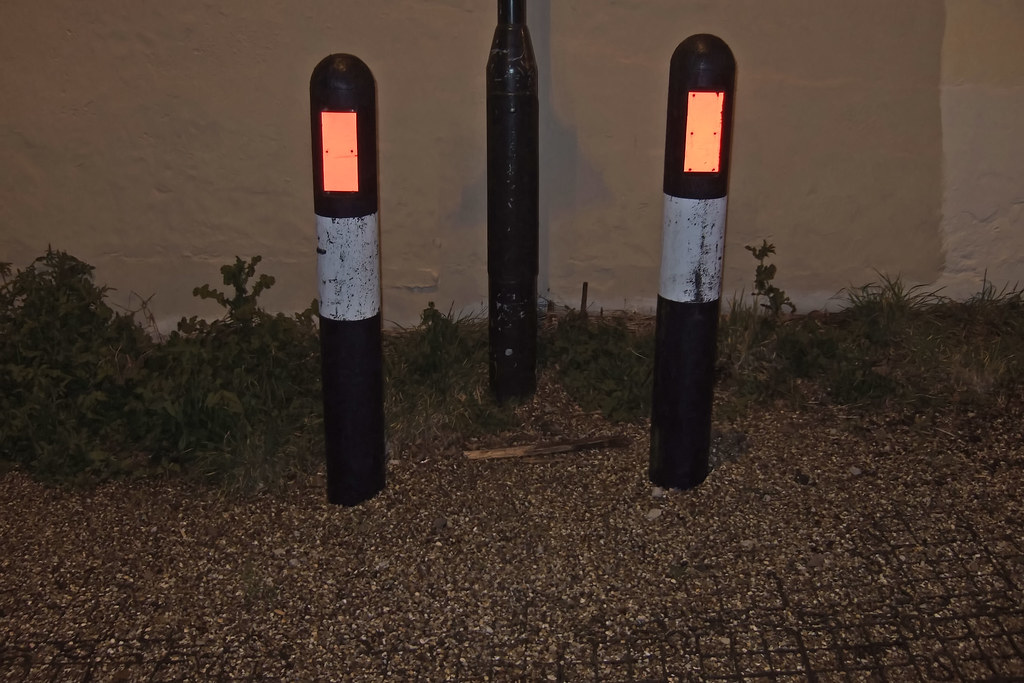
The solution lies in adding reflective materials to the chain or the posts themselves. High-visibility sleeves, reflective tape, or even powder-coated finishes in bright colours can make a significant difference. These additions are not just cosmetic; they serve a critical warning function. A driver approaching a poorly lit parking lot or a pedestrian walking along a demarcated pathway needs that visual cue to avoid a collision.
Compliance with local regulations often demands this level of foresight. Standards such as SANS 10400 address public safety, and many municipal bylaws require that any permanent or temporary barrier be clearly visible. Failure to meet these requirements can leave a business liable for accidents that occur on their premises. It is not enough to simply install a barrier; you must ensure the barrier communicates its presence effectively.
Here is a practical checklist for assessing your current setup:
– Check the spacing between posts to ensure the chain is taut and does not sag.
– Confirm that reflective elements are installed on both sides of the barrier, facing oncoming traffic.
– Assess the surrounding environment for ambient light pollution that might obscure the barrier.
– Inspect for wear and tear that could dull reflective surfaces over time.
Regular inspections during the evening hours are essential. What looks perfectly safe during a daytime walkthrough can be a hidden hazard after dark. Making this a standard part of your security review ensures that your bollards with chain link continue to perform their intended function around the clock. Take the time to look at your barriers from the perspective of a driver with headlights on, rather than a pedestrian with a clear view. That single shift in perspective can reveal exactly what needs to be improved. If you are unsure whether your current installation passes the test, ask a professional to conduct a night-time audit, or simply request a photometric test to measure the actual visibility of your setup.
Regulatory Codes, Permits, and Zoning Requirements
In South Africa, regulatory codes often determine where bollards with chain link can actually exist. Municipal bylaws treat these barriers as permanent structures, not casual additions. Zoning requirements may demand specific setbacks, height restrictions, or even heritage approvals before installation begins. A property owner who skips this step tends to learn about it during a compliance audit, not a friendly council visit.
Permits are triggered by location and purpose. A private estate may face fewer hurdles than a retail centre bordering a public pavement. Some municipalities require stamped engineering drawings for chain span loads. Others simply want proof that the barrier does not obstruct drainage, utility access, or emergency vehicle routes.
Common compliance checkpoints include:
– Verifying the property’s zoning classification before installation.
– Confirming that the chain link span does not encroach onto municipal land.
– Checking whether a building plan approval is required for the posts.
Bollards with chain link satisfy security needs only when they also satisfy legal ones. SANS standards and local bylaws govern their placement, visibility, and structural integrity. Meeting those requirements protects your perimeter and your standing with the authorities who enforce them.

Balancing Open Access with Deterrence
Balancing open access with effective deterrence requires a nuanced approach. The right setup controls vehicle movement without creating a fortress-like atmosphere. The visual permeability of bollards with chain link provides a clear psychological boundary while maintaining sightlines for pedestrians and security personnel. This transparency discourages casual intrusion yet allows for a welcoming environment that does not feel restrictive.
The choice of materials directly impacts long-term safety and maintenance duties. High-tensile chain and robust posts resist cutting and ramming, but they also require regular inspection to ensure tension remains correct and components are free from corrosion. Compliance with safety standards is a continuous process, not a one-time installation.
Here are the primary factors that inform a secure and compliant layout:
– Clear sightlines for motorists and pedestrians.
– Sufficient spacing to prevent bicycle or motorcycle access.
– Appropriate height to deter climbing without obstructing views.
– Adequate reflectivity for nighttime visibility.
Each decision influences both security performance and adherence to local regulations. A well-designed system fulfills its protective role and avoids creating liabilities through obstruction or poor visibility. Ultimately, the goal is to achieve a seamless integration where security measures enhance the space without dominating it, respecting both safety protocols and the user experience. This balance ensures the perimeter remains functional, accessible, and entirely within the bounds of compliance.
Integration with Access Control and Signage Systems
Access control and signage should not be afterthoughts when specifying bollards with chain link. A perimeter that secures the boundary but fails to communicate its purpose creates confusion, especially in shared spaces where delivery vehicles and pedestrians cross paths. In South Africa, where load shedding affects electronic access systems, mechanical fallbacks matter. Key integration points include:
- Card readers and intercoms mounted on posts, with clear sightlines to the chain line
- Reflective signage that remains visible during power outages
- CCTV sightlines that account for the open weave of the chain
When bollards with chain link are paired with proper signage, they comply with local bylaws that require warning markings and unobstructed emergency access. A well-integrated system signals intent without obstructing movement, and that distinction matters for security teams and daily users alike!



0 Comments